This article is published by THMINS and includes a link to our own product on Amazon. As an Amazon Associate, we earn from qualifying purchases.
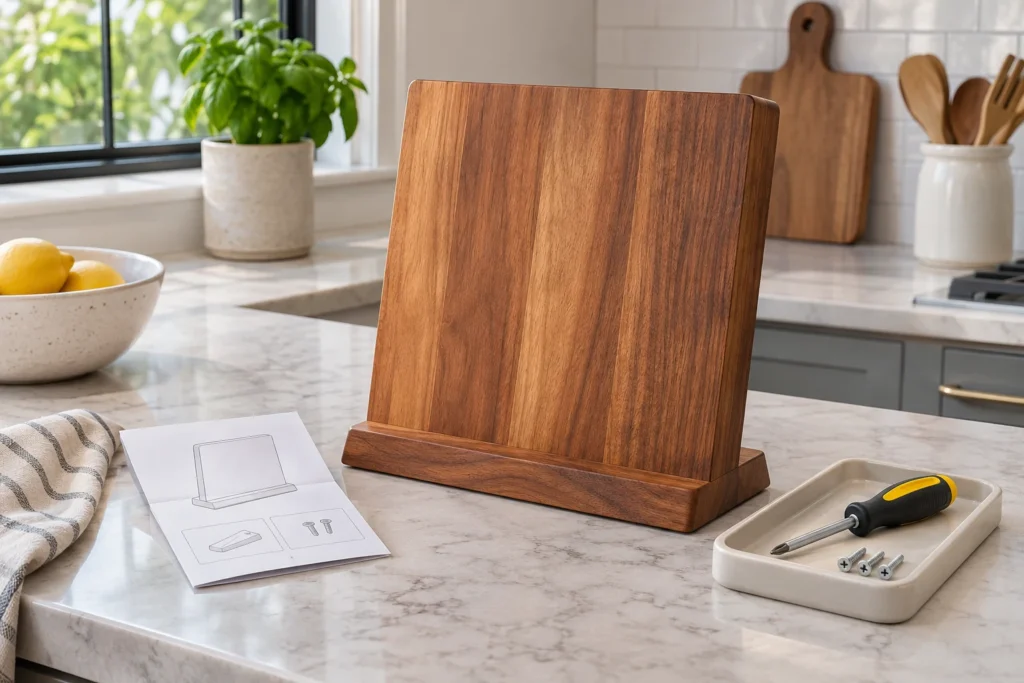
Consider the setup work before checkout. AI-generated, unbranded concept scene; the parts and leaflet do not represent THMINS assembly instructions.
An assembly-required magnetic knife block can be a reasonable purchase when its parts, instructions, and support are clear. An assembled model can be more convenient when you want to avoid a small setup project. Neither description proves quality by itself. The useful buying question is whether the amount of work and uncertainty suits the person who will receive and use the holder.
This matters when a block arrives before a busy holiday meal, goes to a college apartment, or is purchased for someone who does not keep tools at home. A listing photo generally shows the finished product. It may say little about the parts inside the box or what happens when they do not fit. Check those details before treating two similar-looking blocks as interchangeable purchases.
Why assembly deserves attention before checkout
In the HOSHANHO reviews we read, one verified two-star buyer said the product looked attractive but the pieces would not fit together. A verified one-star buyer of the same listed 14-by-10-by-4.5-inch variant also described pieces that would not slide into place, despite liking the magnets and wood. These accounts identify an assembly concern; they do not establish how frequently it occurs or describe THMINS products. Two-star account, one-star account.
A positive rating is not an assembly guarantee either. Another model’s owner may have received a fully assembled holder, a different base design, or a different set of parts. When comparing feedback, match the variant and the setup described. “Easy to use” after assembly and “easy to assemble” are separate observations.
Ask what arrives in the box
Start with a simple question: does this exact variant arrive ready to stand on the counter, or does the buyer attach the base, feet, guard, or another structural component? Then ask for the parts list and instruction sheet. A statement that assembly is easy is less useful than knowing which connections you will be asked to make.
Check whether the required tool is included and whether an ordinary household tool is specified. Do not assume that every screw head accepts the same screwdriver or that a power driver is appropriate. The instructions should explain the intended setup. If a seller cannot provide them before purchase, record that as an unresolved detail rather than guessing from customer photographs.
For a gift, the distinction is particularly important. The recipient may not have a suitable workspace or tools available on the day they open it. A ready-assembled product may justify a preference for convenience, while an assembly-required design may be entirely acceptable to someone who is comfortable with the documented task. The choice depends on the recipient, not on whether assembly sounds easy to the buyer.
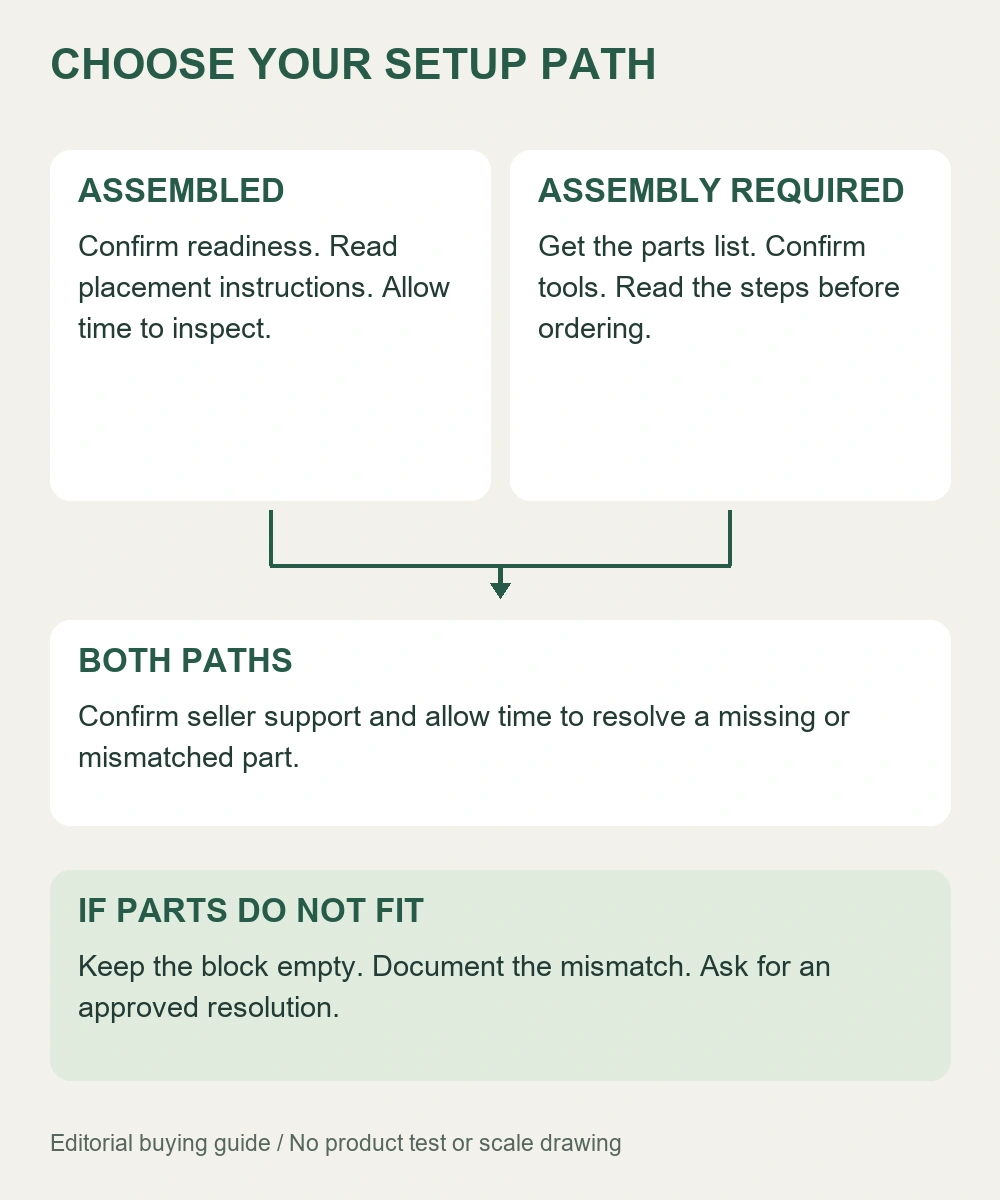
Two purchase paths with different setup needs; neither path establishes product quality.
Separate a manageable task from a repair project
Putting supplied parts together according to clear instructions is different from correcting holes that do not align or altering a joint that will not fit. The first is ordinary setup. The second raises a product-condition question for the seller. Do not budget your time on the assumption that you can repair any mismatch after delivery.
Before ordering, ask how the seller handles missing hardware, an absent foot, or a component that cannot be assembled as shown. Is a model-specific replacement part available? Would the entire item need to be returned? The relevant terms are those displayed for the actual offer at purchase time; they can differ by seller and change later. Keep a copy of the order details and instructions for reference.
A verified one-star HOSHANHO reviewer reported separate problems involving a missing pad and mismatched parts across two deliveries. That is one buyer’s account, not a measured defect rate or a prediction about another order. It does explain why replacement-part support is a meaningful question before checkout. Parts-related review.
Think about when you need the holder
Suppose you want the new knife storage ready for Thanksgiving cooking. Ordering a model that requires assembly on the evening before guests arrive leaves little time to resolve a missing part. Even an assembled item deserves time for an ordinary condition check. Build some flexibility into the purchase rather than letting the meal deadline pressure you into using an incomplete setup.
The same principle applies to a move. If the household tools are packed and the kitchen counter is covered with boxes, an assembly-required holder may create an avoidable task. You can still choose it, but plan to assemble it when the workspace and instructions are available. Until then, keep knives in their existing suitable protected storage instead of treating the unpacked parts as a temporary stand.
This is a purchasing decision about timing, not a claim that assembly-required models are inferior. A buyer who enjoys a straightforward documented setup may see no disadvantage. A buyer who values immediate readiness may reasonably pay attention to assembly status even when the finished designs look similar.
Compare construction details without inventing conclusions
Pictures can help you identify joints and separate components, but they cannot prove that a connection is well made. Ask for a view of the base connection and the underside. Look for consistency between the selected variant, the manual, and the product images. If those disagree, clarify which construction will be delivered.
Avoid treating a screw count as a quality ranking. More hardware does not automatically mean a better holder, and fewer visible parts do not establish durability. Similarly, a one-piece appearance may conceal attached components. Base your comparison on the actual documented setup and support rather than assumptions about how the object was manufactured.
When comparing a THMINS magnetic knife block, verify the assembly requirements for the specific listing. The competitor comments discussed here do not establish whether a THMINS model arrives assembled, which tools it needs, or whether its parts share the same design. Those are product facts to confirm directly.
What to do if the delivered parts do not fit
Keep the block empty and pause the setup. Recheck the model, supplied components, and orientation against the instructions. If the mismatch remains, photograph the relevant parts without knives present and contact the seller. Describe what does not align rather than diagnosing a manufacturing cause you cannot verify.
Do not sand a joint, enlarge a hole, substitute random screws, or add an improvised pad merely to complete the assembly. Such changes can make the condition harder to assess and may alter how the holder works. Seek the manufacturer’s resolution while the original parts and packaging are available. There is no need to load knives to demonstrate that an empty assembly is incomplete.
For a broader inspection after setup, use our first-use checklist. That is the next stage. The decision in this guide comes earlier: choosing a product whose assembly demands fit your circumstances.
Choose the level of setup you actually want
Buy an assembly-required model when the instructions are clear, the required tools are available, and there is a practical route to resolve missing or mismatched parts. Prefer an assembled option when minimizing setup is a meaningful benefit for you or the recipient. Neither choice removes the need to verify the delivered product’s condition.
For a THMINS option, check the selected model and its current included-parts information at View the THMINS magnetic knife block on Amazon. Confirm readiness, support, and timing before comparing appearance. A good purchase should arrive with a manageable plan for getting from the shipping box to normal kitchen use.
Editorial evidence note: Review pages were read on November 17, 2026 (China time). Comments were selected by star rating and may concern different variants. They identify buying questions, not population-wide outcomes. Illustrations are concepts, not product photographs or test evidence.