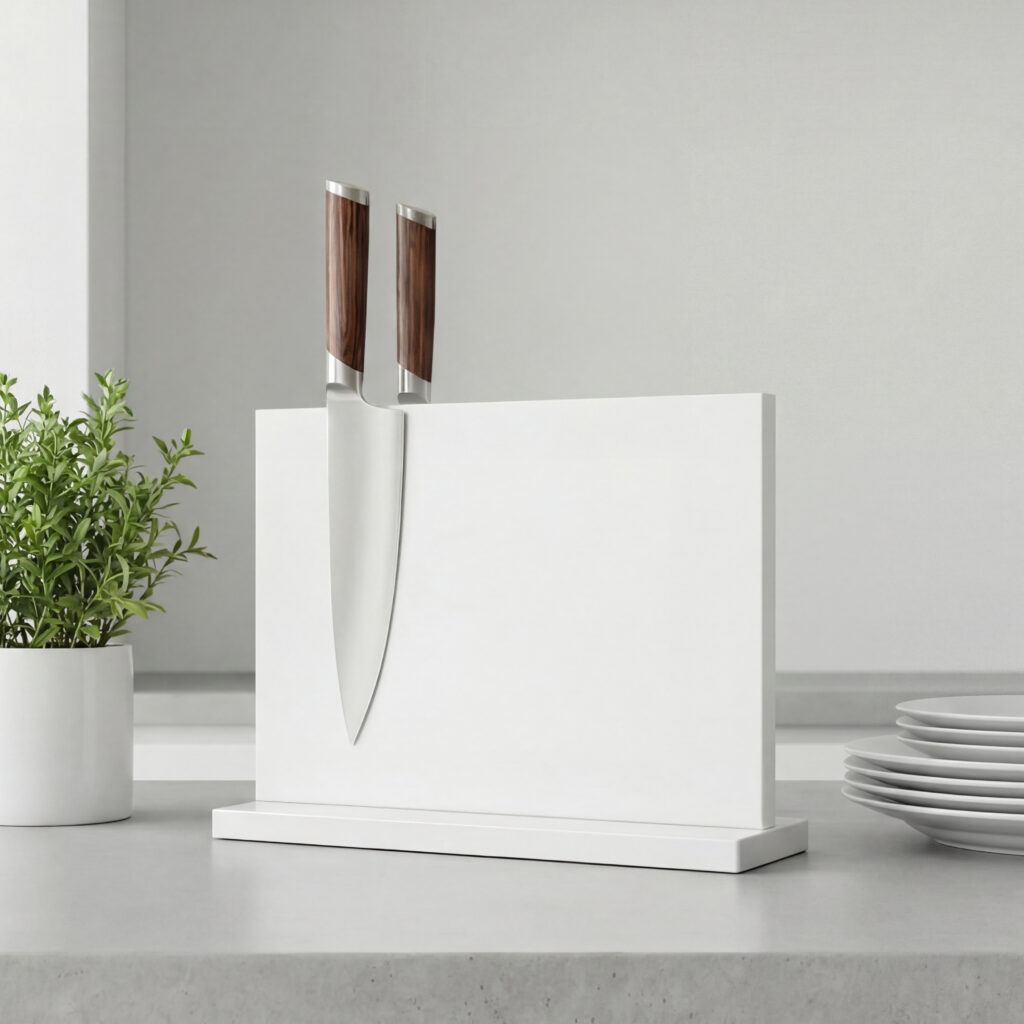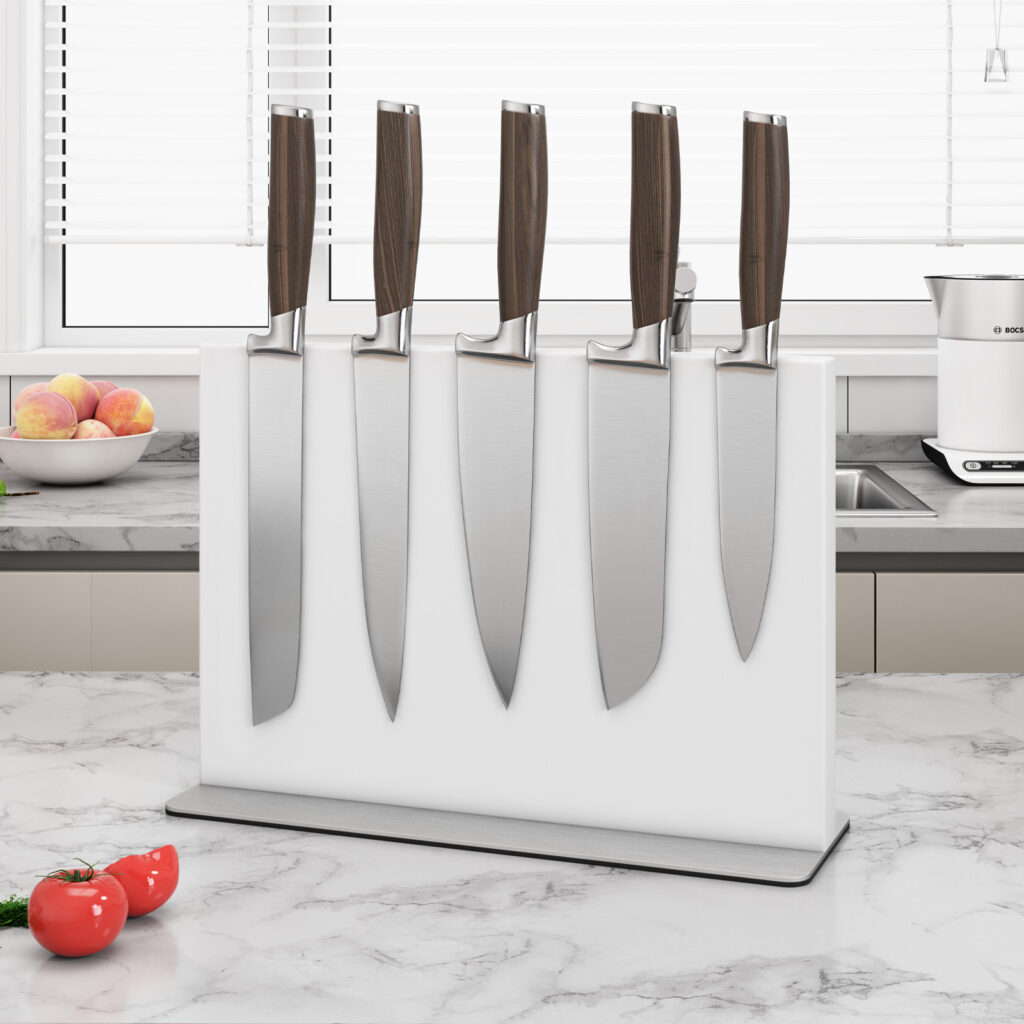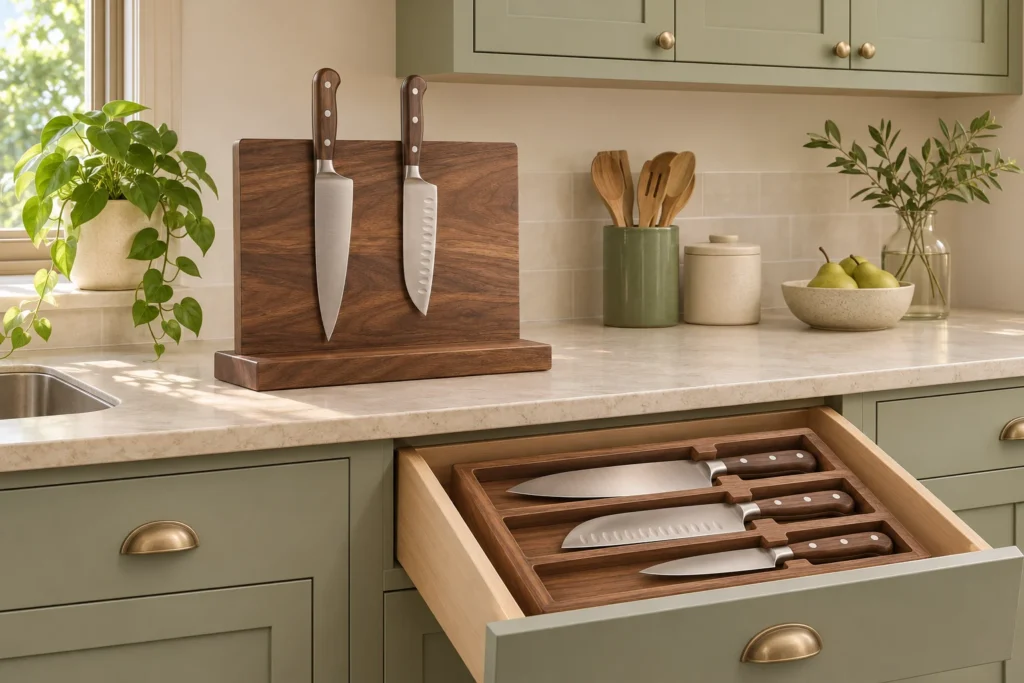
AI-generated concept illustration; not a THMINS product photograph, installation diagram or performance test.
Renting a kitchen does not mean you need to drill into the backsplash to organise your knives. A freestanding magnetic holder or a suitable drawer insert can provide a dedicated place for them without a permanent wall installation. The better choice depends on the counter and drawer space you can actually spare.
Begin with the space you control
Measure an available counter area with your chopping board in its normal position. Include the holder’s complete base, rather than only the width of its storage face. Check whether a cupboard door, kettle or dish rack would interfere with reaching a knife.
For a drawer insert, measure the internal drawer width, depth and usable height. Account for the knife handles and the way the drawer closes. An insert that fits the empty drawer may still be unsuitable for your longest knife.
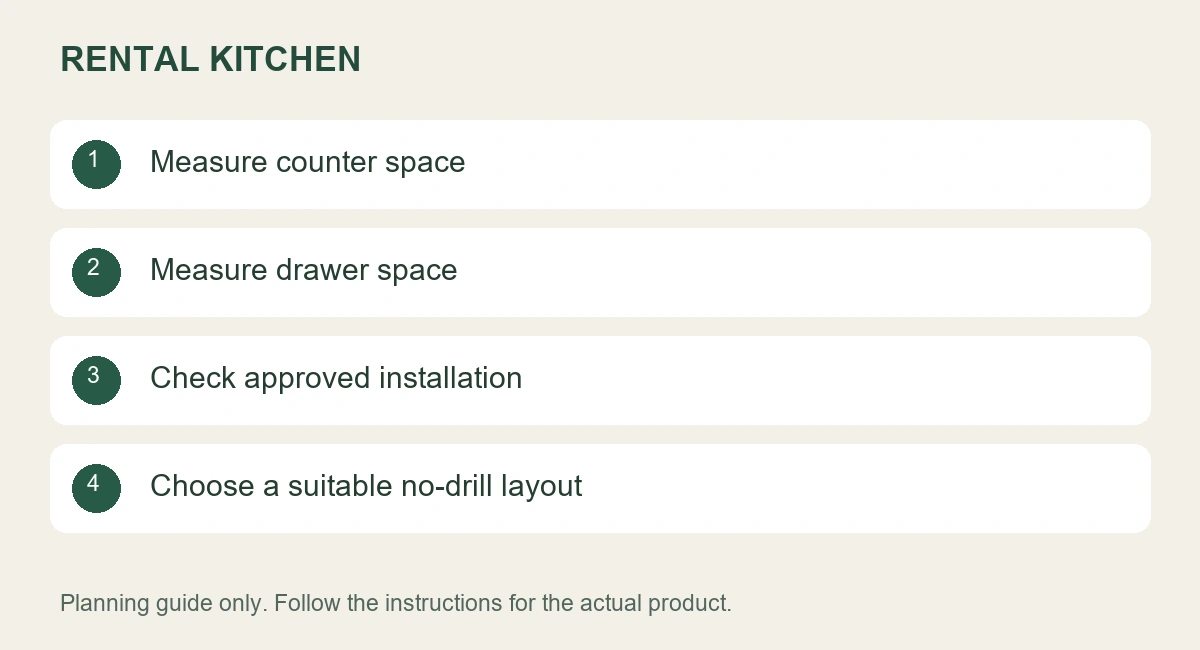
Illustrated planning checklist; follow model-specific instructions.
Compare two practical approaches
| Option | What to check | What you give up |
|---|---|---|
| Freestanding magnetic holder | Knife compatibility, base footprint and removal space | A dedicated area of counter |
| Drawer insert | Slot fit, drawer clearance and protected blade separation | Part of a drawer |
A countertop holder keeps the selected knives visible. A drawer solution keeps them out of sight. Neither arrangement should require moving other sharp tools whenever you need one knife.
Treat adhesive mounting as a separate installation decision
“No drilling” does not automatically mean an adhesive installation is appropriate for a loaded knife rack. Check whether the rack manufacturer approves that installation method for the exact product and wall surface. Also check the tenancy requirements before attaching anything to a finish that could be damaged during removal.
Do not replace supplied mounting hardware with household adhesive simply to avoid making holes. If approved installation is not possible, choose a freestanding or drawer design intended for that purpose.
Plan for your next move
Keep the instructions and model details with your household records. Before moving a countertop holder, remove and pack the knives in appropriate protective storage. Recheck the new kitchen location rather than assuming the old arrangement will transfer unchanged.
Compare a rental kitchen in three everyday situations
Consider a kitchen with a narrow preparation counter, a usable top drawer and a tiled backsplash that you cannot alter. A freestanding block initially looks attractive because there is no installation. However, if its base occupies the only space beside the chopping board, a fitted drawer insert may offer the more practical arrangement. The decision comes from how the space is used during cooking, not from whether the holder can physically stand there when the counter is empty.
Now consider the opposite situation: drawers are shallow or already required for utensils, but there is a clear counter section beside the preparation area. A suitable countertop magnetic holder may give the regular knives an identifiable home without reorganising every drawer. Confirm that the proposed location remains clear when you use appliances, unpack groceries and put dishes away. A storage position that works only after moving three other items is likely to become inconvenient.
A third kitchen may offer neither suitable counter space nor a suitable drawer. In that situation, avoid buying a holder merely because it is advertised as compact. Keep the knives in an appropriate existing protected arrangement while you investigate another location or obtain permission for an approved installation. Lack of an ideal location is useful information discovered before purchase.
Ask installation questions in the right order
For any wall-mounted product, first identify the approved mounting method and substrate requirements. Then establish whether the property permits that method. Finally, consider what restoring the surface would involve when the tenancy ends. These are different questions: permission to attach something does not establish that the attachment method is suitable for the product, and a suitable mounting method does not establish permission to use it in a rental.
If a listing mentions removable adhesive, request the exact instructions rather than relying on the word removable. Surface condition, preparation, installation and removal requirements belong to the specific system. Do not combine a rack from one supplier with an unrelated adhesive on the assumption that their separate descriptions establish a compatible setup. A purpose-designed freestanding alternative removes this mounting decision, although its own placement requirements still apply.
Prepare a useful shortlist
Write one line for the available counter footprint and one for the usable drawer interior. Next, list your everyday knives and any unusual blade or handle dimensions. This gives you enough information to eliminate products that cannot fit without comparing every aesthetic detail first. Keep appearance as a later choice among arrangements that actually work.
When contacting a seller, describe the kitchen constraint directly: you cannot drill, your counter has a particular clear area, and your longest knife is a named model. Ask which dimensions refer to the complete base and which refer to the storage face. If a proposed product has a guard, ask how the knife is removed and whether cabinet clearance affects that movement.
Build a reversible layout without improvised modifications
A rental-friendly arrangement should be easy to reassess when appliances or furniture change. Keep the holder in its intended configuration, retain the instructions and avoid alterations to feet, guards or mounting components. Reversible organisation means choosing a suitable location and product; it does not mean improvising structural changes that can later be undone.
After moving into a new property, repeat the empty-space planning before unpacking the knives into their final positions. Different counters, lighting fittings and cabinet doors can change access even when the kitchen appears similar. Keep the knives protected during this assessment and settle the location before loading the holder.
What if my landlord allows adhesive but not screws?
That permission resolves only the property question. You still need a rack and adhesive mounting system explicitly intended to work together on the actual surface. If the product requires screws, choose a different approved storage arrangement rather than treating permission for adhesive as a substitute for the installation instructions.
Can a countertop holder sit anywhere?
It needs a suitable stable surface, clearance for normal use and a location protected from accidental knocks. A narrow shelf or crowded counter edge is not equivalent to a clear preparation area.
Is a drawer insert always more compact?
It saves counter area but occupies drawer space. Compare the space you have available, not just the exterior dimensions of the products.
For the next step, use the knife holder size guide to prepare your measurements before comparing models.