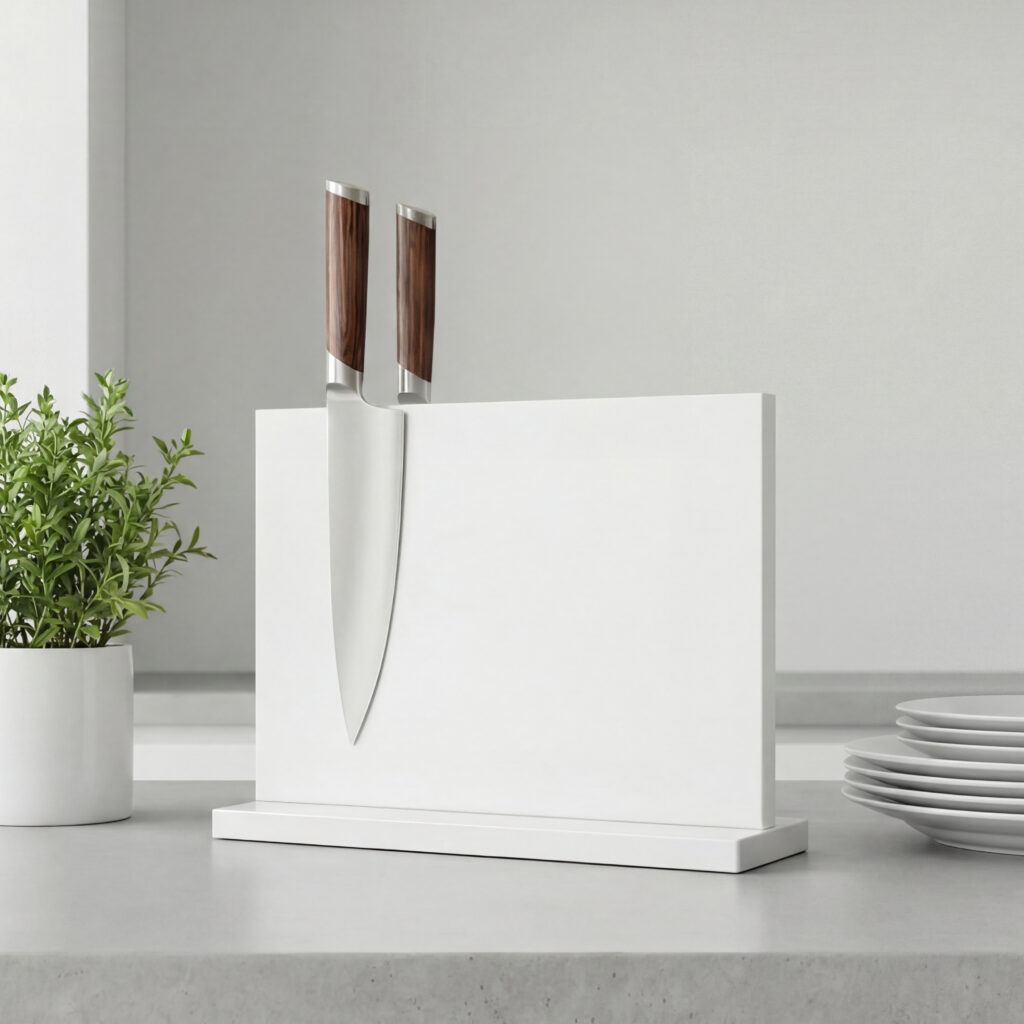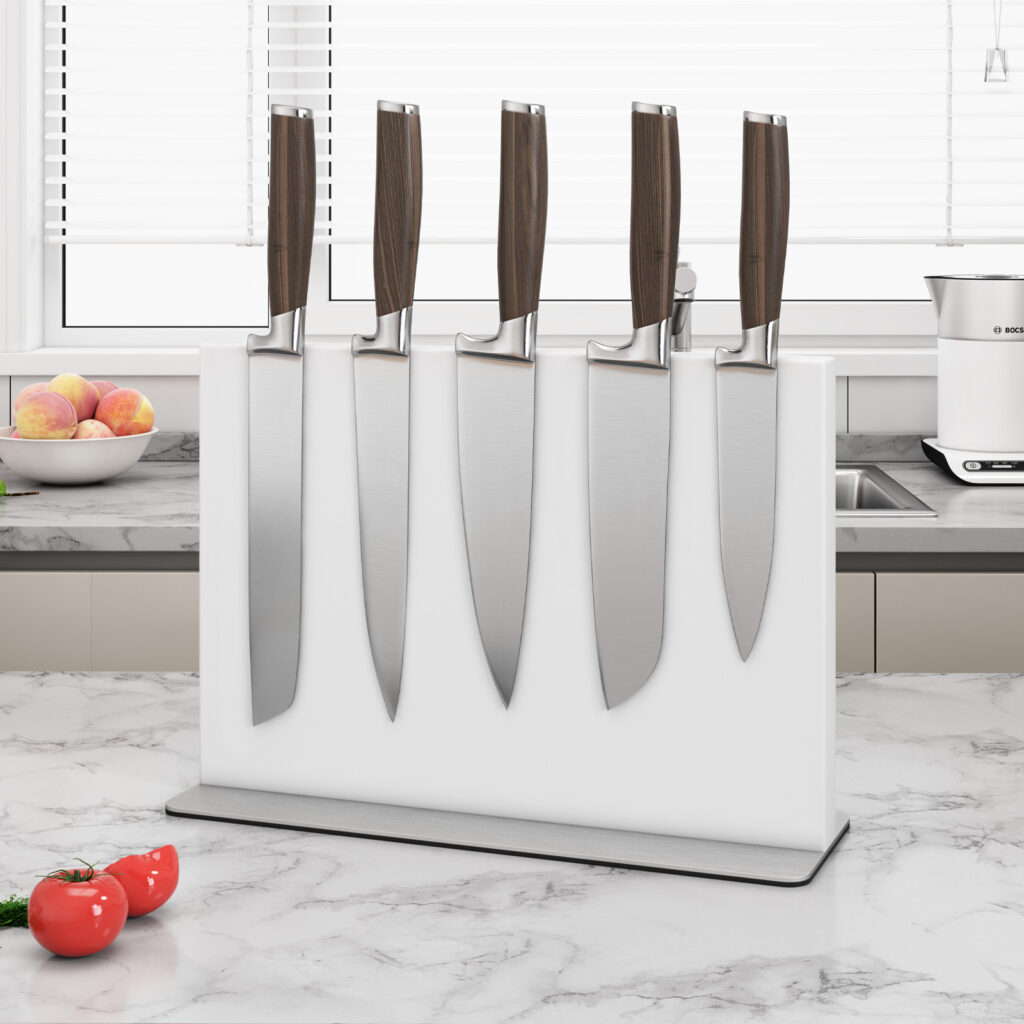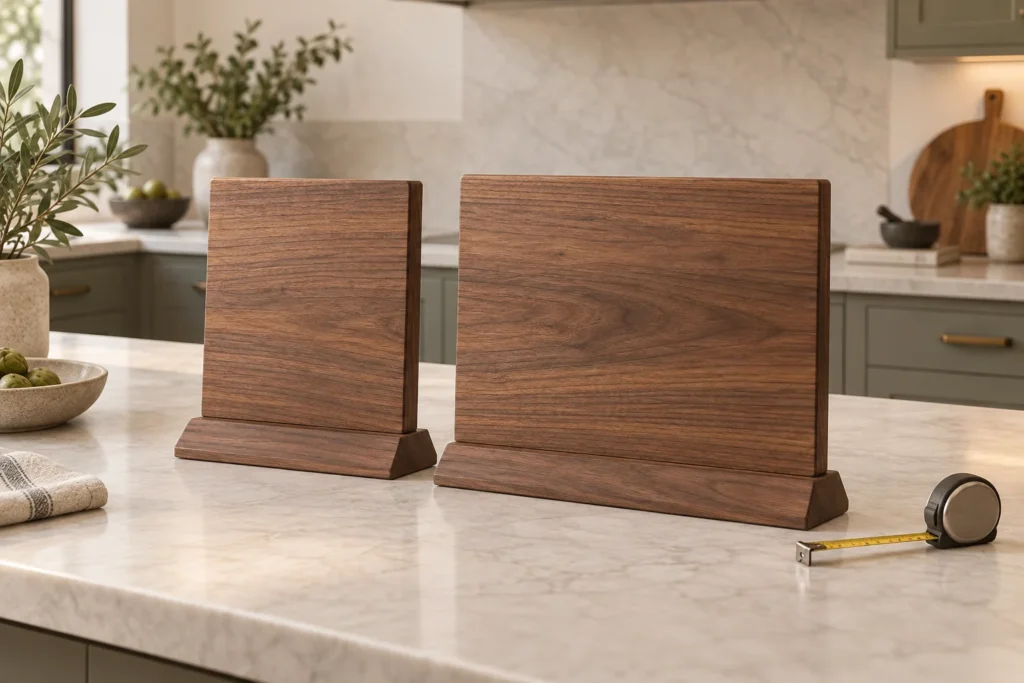
AI-generated concept illustration; not a THMINS product photograph, installation diagram or performance test.
A magnetic knife holder used successfully in one kitchen still needs a fresh placement check after a move. Counter depth, cabinet height and the route around a cooking area can change how the same holder works. Plan transport and the new layout as separate tasks.
Remove knives before packing the holder
Do not transport a loaded magnetic block as if magnetic attachment were travel protection. Remove each knife using the intended method and pack it in suitable protective storage for transport. Keep sharp items identifiable and separated from loose household objects.
If you are using a removal service, ask about its packing requirements for kitchen knives. Do not assume a towel wrapped around a blade is equivalent to purpose-made protection.
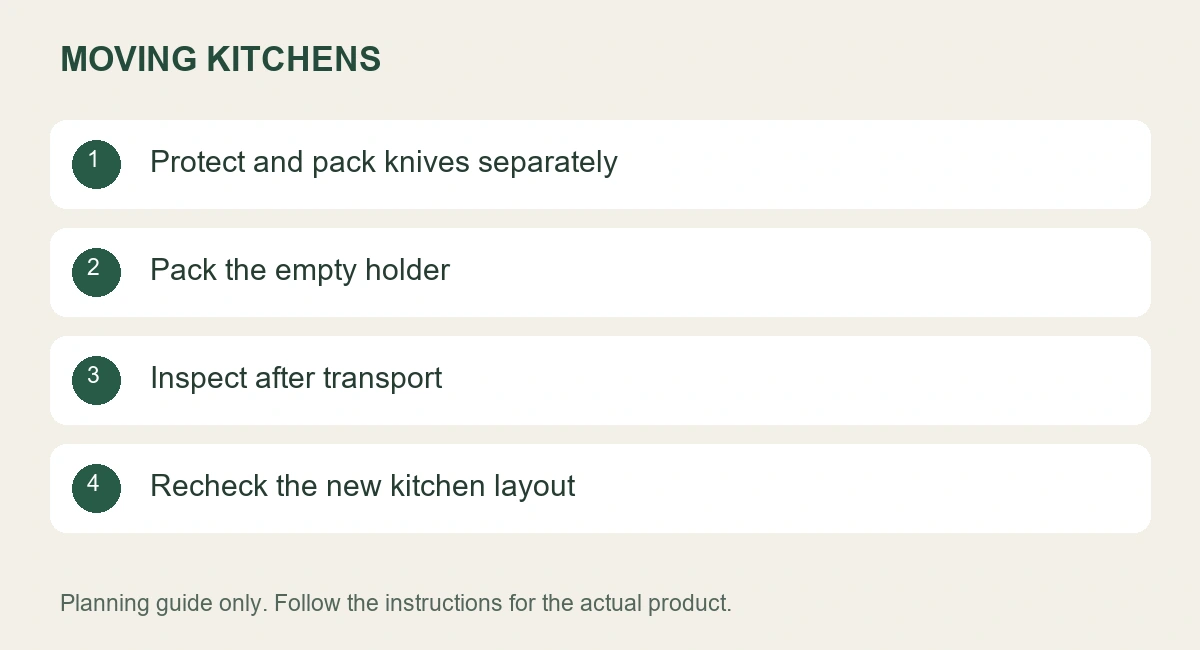
Illustrated planning checklist; follow model-specific instructions.
Prepare the holder according to its instructions
Clean and dry it as directed before packing. Retain any approved removable components and hardware together in a labelled packet. Leave fixed guards and structural parts assembled unless the instructions permit dismantling.
Protect the surfaces and projecting parts during transport. Keep the manual or a copy of the model information accessible so you can check setup requirements without searching every box.
Inspect before reusing it
After unpacking, examine the empty holder for damage, missing feet or loose parts. Resolve any problem with the supplier before loading knives. A familiar product should receive the same condition check as one that has just arrived.
Reassess the new location
| New kitchen feature | What to check |
|---|---|
| Shallower counter | Complete base footprint and working room |
| Lower cabinet | Handle height and removal path |
| Different preparation area | Access without crossing other tasks |
| Nearby backsplash | Rear access for double sided storage |
Use a paper footprint to compare positions while the knives remain packed. The spot that looks most similar to the old kitchen may not provide the best access in the new one.
Make a packing list before moving day
After unpacking, store the transport protection where it can be found for future use. A labelled location for blade guards, packing inserts and instructions makes the next move easier to prepare. Check their condition before reusing them rather than assuming that surviving one journey means they remain suitable indefinitely. Keep these packing accessories separate from the ordinary cooking area once the kitchen is organised.
Keep the packed kitchen knives separate from the tools used to open moving boxes. A kitchen knife should not become an improvised packing tool simply because it is the first sharp object available. Prepare an appropriate box-opening tool and return it to its own location after use. This keeps unpacking activity separate from the process of preparing the knives and holder for their intended kitchen roles.
List the knives and their protective storage, the holder, any approved removable parts and the instructions. Keep this list with the kitchen packing information so you can check that every component reaches the new home. A small packet of hardware is easy to misplace if it is packed separately without a label identifying the product.
Prepare the protective storage before removing knives from the holder. This avoids creating an intermediate pile of exposed blades while searching for packing materials. Use products intended to protect the knives during transport and follow any requirements from the removal service. Keep the packed knives identifiable to the adults handling the kitchen boxes.
Separate transport requirements from countertop use
Magnetic attachment in an ordinary kitchen setting is not a transport restraint. Movement in a vehicle, changes in orientation and contact with other packed objects are different conditions from a holder resting on a counter. Do not leave knives attached because they seemed secure during everyday cooking.
The holder also needs its own protection. Pack it so its finish, feet and guards are not pressed against hard objects or used to support other boxes. Follow the manufacturer’s guidance for any parts that can be removed, and do not dismantle a fixed structure just to reduce packing volume.
Keep moisture out of the packing process
Complete the approved cleaning and drying process before packing either the knives or holder. Avoid wrapping a recently cleaned item while moisture remains in joints, guards or contact areas. Follow the relevant care instructions for each material rather than applying one cleaning routine to the entire set.
If unpacking will be delayed, retain the manufacturer’s storage guidance with the items. A moving box is a temporary transport arrangement, not automatically an appropriate long-term storage environment. When you unpack, inspect the condition before returning the items to everyday service.
Rebuild the kitchen routine in stages
First identify the new preparation area, sink and appliance positions. Next, compare possible storage locations using the empty holder or a paper footprint. Finally, confirm knife fit and access before placing the collection into its normal positions. This order avoids organising the knives around a location that later proves unsuitable for cooking.
Do not let the first available patch of counter become the permanent location simply because it was convenient during unpacking. Moving day creates temporary piles and unfamiliar routes. Reassess once the main appliances and everyday utensils are in their intended positions.
Consider changes in the household as well as the room
A move may introduce shared cooking, an open-plan island or a different route through the kitchen. These changes can affect who approaches the holder and from which direction. An arrangement that was tucked against a wall in the old home may expose a second face toward seating in the new one.
Evaluate whether visible, accessible knife storage remains appropriate for everyone who uses the space. If it does not, choose a protected arrangement with suitable access controls. Keeping a familiar product does not require keeping the same storage method when the household circumstances have changed.
What if a foot is missing after the move?
Keep the holder out of use until the supplier identifies the correct replacement or other approved resolution. Do not level the base with folded paper or an unrelated pad. The intended contact between the base and counter is part of the product’s setup, not merely an appearance detail.
Can I reuse the old wall mounting hardware?
Check the rack instructions and the new wall construction before any installation. Hardware that was suitable for one surface may not be appropriate for another, and its condition also matters. Obtain the required mounting guidance instead of assuming that moving the same rack means repeating the same installation.
Can I remove a wall rack and use it as a countertop holder?
Only if it is explicitly designed for that configuration with the required parts. A wall rack should not be treated as a freestanding block by adding an improvised support.
Should the old arrangement be recreated exactly?
Retain a familiar knife order if it remains suitable, but adapt the location to the new space. Use the holder size checklist to check footprint, height and surrounding clearance together.