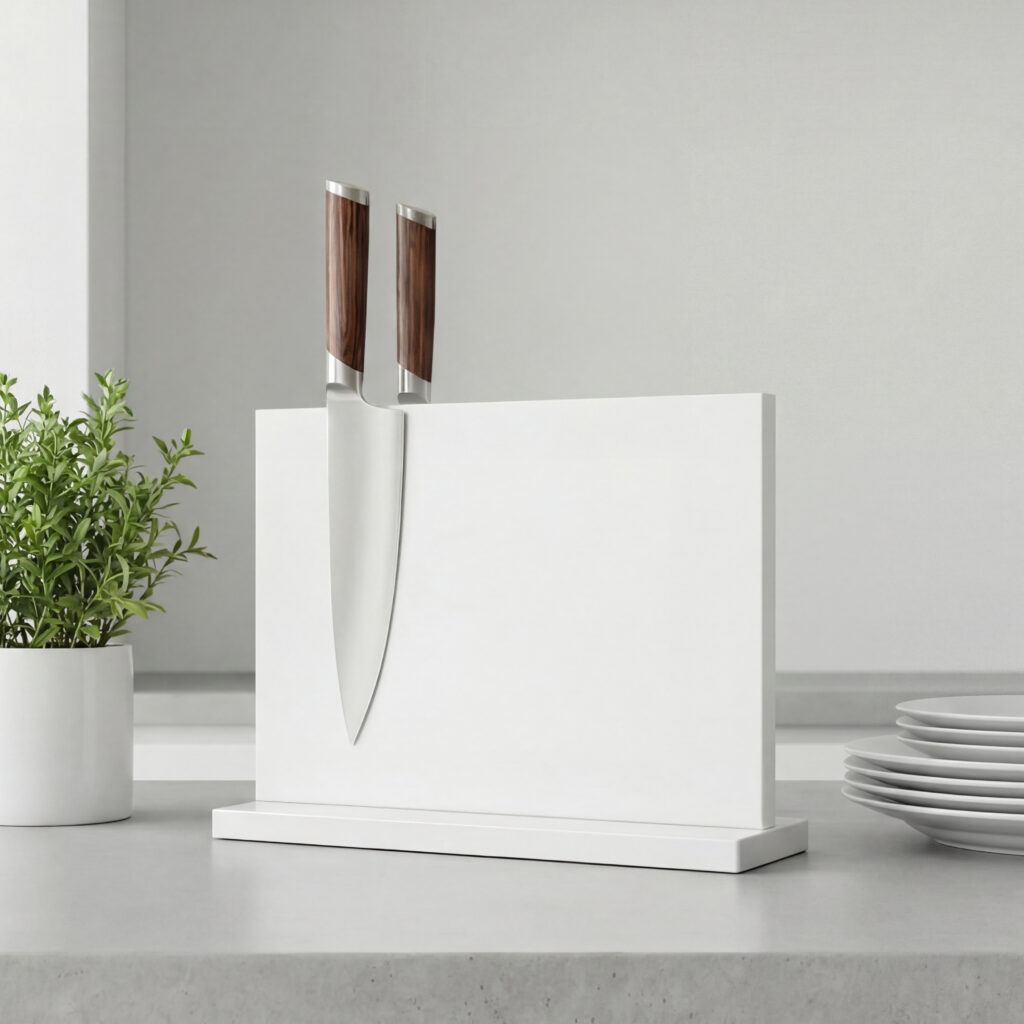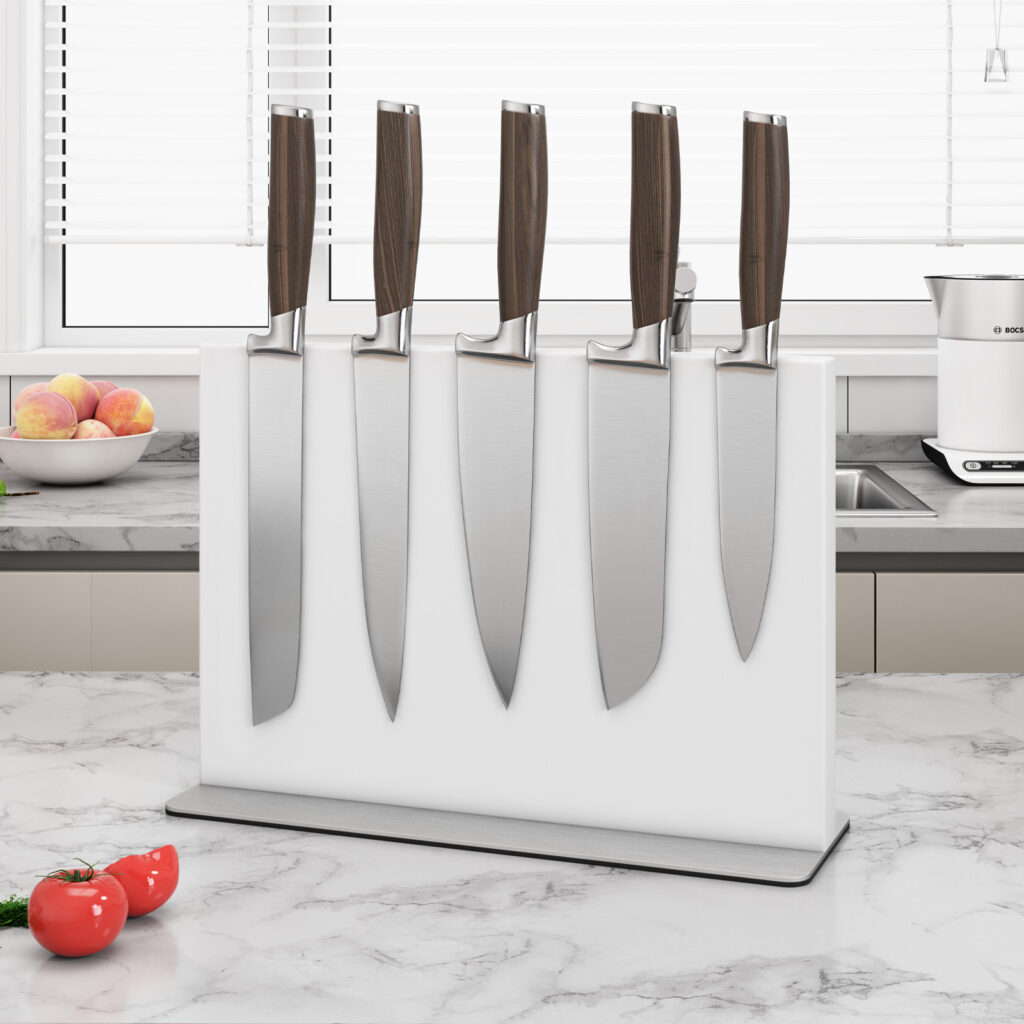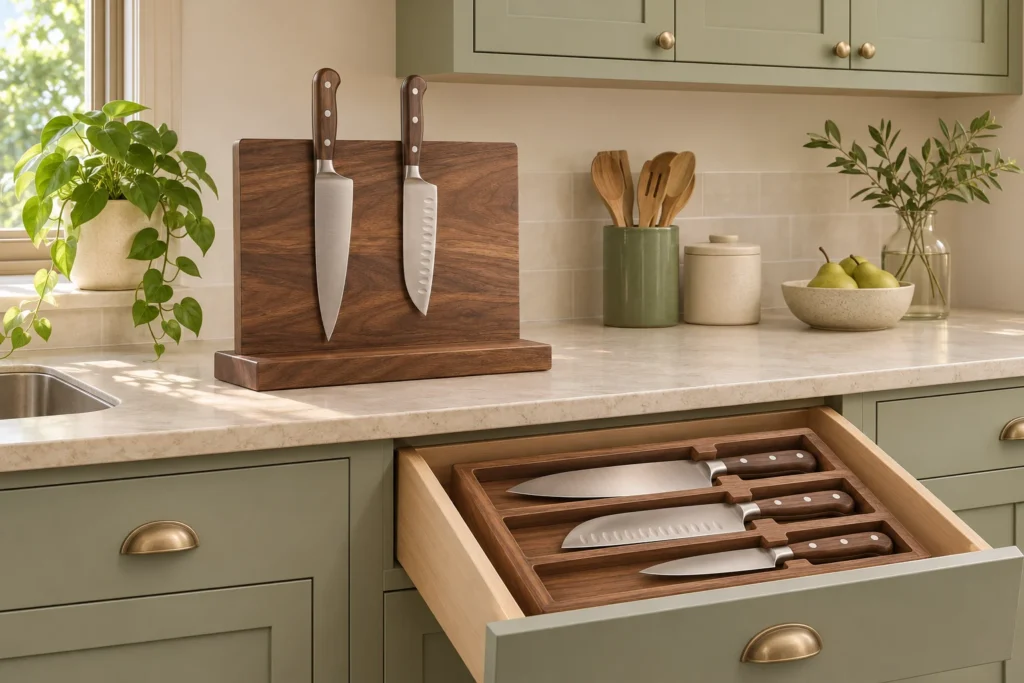
AI-generated concept illustration; not a THMINS product photograph, installation diagram or performance test.
A magnetic knife holder and a drawer insert solve different space problems. The holder dedicates visible counter space to knives; the insert dedicates space inside a drawer. Choose the arrangement that gives each everyday knife a protected, accessible position without disrupting the rest of your kitchen.
Follow one ordinary meal through the kitchen
Think about preparing vegetables, switching knives and cleaning up. Where do you stand? Which drawer is already open? Does another person need to pass behind you? These details often matter more than whether a storage product looks compact in a photograph.
A magnetic holder may be convenient beside a clear preparation area. A drawer insert may suit a kitchen where the counter is already occupied, provided the drawer opens freely and the knives remain individually accessible.
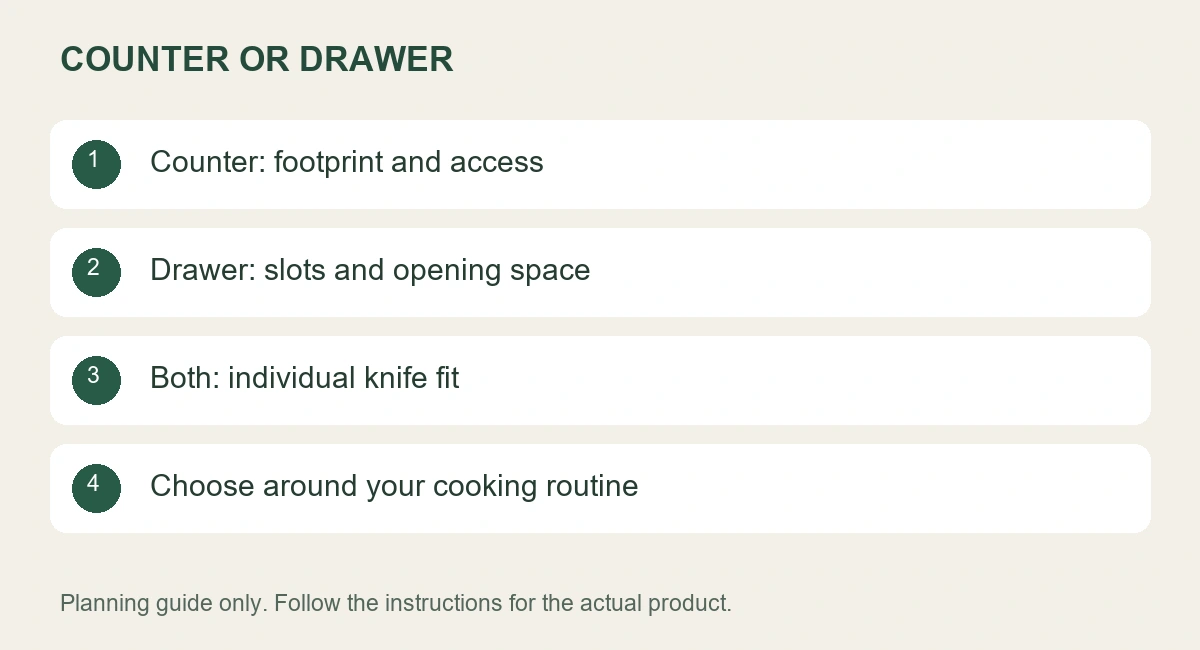
Illustrated planning checklist; follow model-specific instructions.
Compare fit before capacity
For a magnetic holder, check the blade’s compatibility and intended attachment position. For an insert, check the slot dimensions, handle clearance and whether the knife sits as the insert manufacturer intends. Neither a generic knife count nor a photo establishes fit for an unusual blade.
| Decision | Magnetic holder | Drawer insert |
|---|---|---|
| Where space is needed | Counter or approved wall location | Inside an accessible drawer |
| What limits fit | Attachment compatibility and usable surface | Slot shape, blade length and drawer height |
| What to examine during use | Stable removal and clear handle access | Separation and unobstructed drawer movement |
Consider the household
Open display is a preference, not a requirement. If accessible blades are unsuitable for your household, choose protected storage with appropriate access controls. A drawer is not automatically child-resistant simply because the contents are hidden.
In a shared kitchen, agree where knives are returned. A consistent layout helps people find the correct handle without moving neighbouring tools. Avoid turning either storage system into a mixed compartment for loose utensils.
A combined arrangement can make sense
You do not have to put every knife in the same place. A suitable holder can carry frequently used compatible knives while a protected insert accommodates occasional-use or incompatible blades. Keep each location deliberate so knives do not become scattered across the kitchen.
Compare the space during use as well as at rest
A drawer insert has two footprints: the space it occupies inside the drawer and the space needed in front when the drawer is open. In a narrow kitchen, an open drawer can affect another person’s route between the sink and preparation area. Check that a cook can retrieve a knife without leaving the drawer projecting into a busy passage. The exterior view of a closed cabinet does not show this practical constraint.
A countertop holder also needs more than its base footprint. The hand must approach the handle and complete the recommended removal movement. A holder positioned between an appliance and a wall can fit neatly while leaving little room to use it. Compare the whole action with each system, using an empty holder or paper outlines during planning rather than repeatedly handling exposed knives.
Separate edge protection from visibility
Visible knives are easier to identify by their complete shape, but visibility alone does not establish a suitable storage method. Examine the actual contact points and the position of neighbouring blades. A magnetic design should support compatible knives as intended, without tips resting against an unintended surface. A drawer insert should accommodate the actual knife profile without trapping the handle or forcing the blade into an unsuitable slot.
Likewise, a closed drawer is visually tidy but does not make a loose collection of knives organised. The insert needs to keep knives in their intended individual positions. Avoid stacking a second layer of tools over the knives simply because the drawer has spare height. That arrangement can defeat the purpose of selecting a dedicated insert.
Think about cleaning the storage system itself
For a drawer arrangement, consider whether the insert can be removed as instructed and whether you can access the drawer surface beneath it. A tight fit that prevents normal cleaning may create extra work. Look at the layout of slots and recesses and ask how residue is removed without using sharp tools to probe narrow spaces.
For a countertop holder, consider the contact surface, edges and area around the base. A holder beside a cooking zone may encounter splashes, while one near the sink may encounter water. Follow its finish-specific care instructions. Neither product category has a universal cleaning advantage; the useful comparison is between the designs you are considering and the conditions of your kitchen.
A practical example of combining both systems
Imagine a cook who uses a chef knife and a small utility knife daily but brings out a long slicer only for occasional meals. A suitably sized magnetic holder might serve the two daily knives, while a compatible protected drawer position accommodates the slicer. This arrangement prioritises access without buying a large countertop block solely for an infrequently used blade.
The reverse can also work. A drawer may hold most knives comfortably, while a particular knife requires another protected location because its handle does not fit the insert. The point is to assign each knife a deliberate place. A combined system becomes less useful when it creates several temporary locations that other household members cannot predict.
Decide what problem justifies a change
Write down the main limitation of your current storage in one sentence. Perhaps the drawer cannot close comfortably, the block occupies needed preparation space, or the handle of a particular knife is difficult to reach. Compare alternatives against that problem first. A purchase that improves appearance but leaves the original access problem unchanged is unlikely to feel satisfactory in everyday cooking.
Then decide what trade-off you are willing to accept. Giving up a small part of the counter may be reasonable if it releases a useful drawer. Giving up drawer space may be reasonable if it restores the only clear preparation area. Neither trade-off can be evaluated from a product photo without understanding the kitchen.
Can I decide using the advertised knife count?
Use it as a prompt for questions, not as proof that your collection will fit. Ask which knives or dimensions were used to describe that capacity, and compare their blade and handle shapes with your own. This applies to both magnetic surfaces and slotted inserts.
Which option protects the cutting edge better?
The useful comparison is between the actual designs and how the knives contact them. Check whether an edge touches an unintended hard surface and whether adjacent tools can collide.
Should I replace a storage system that already works?
Identify the problem first. If access, fit and space are satisfactory, a different appearance alone does not establish a functional improvement. For contact concerns, read the knife scratches and everyday care guide.