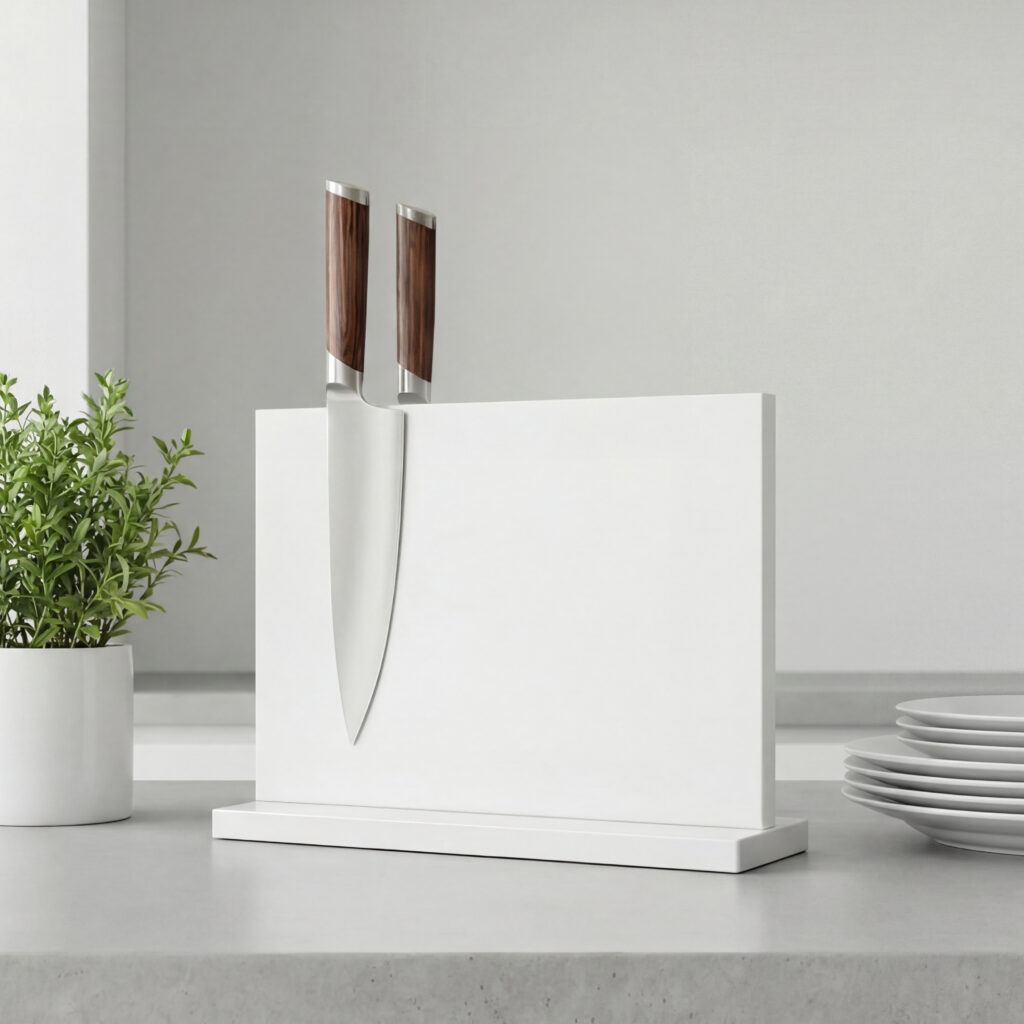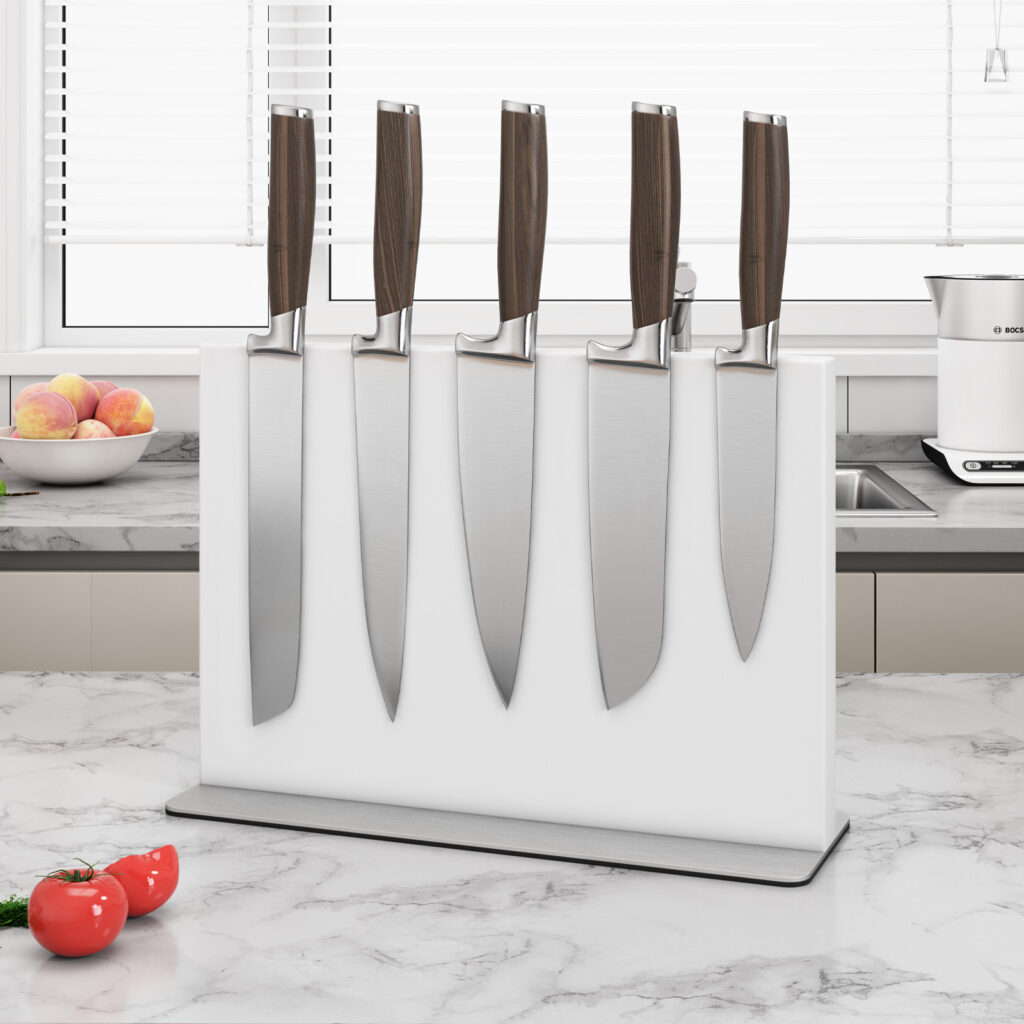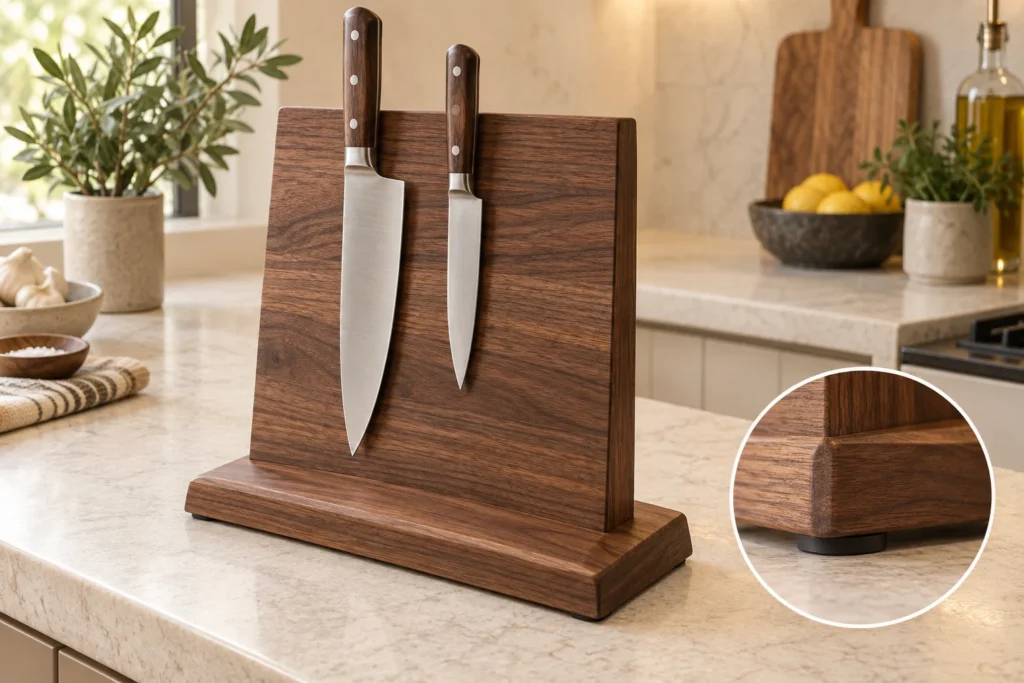
AI-generated concept illustration; not a THMINS product photograph, installation diagram or performance test.
A long bread knife needs more than an empty strip of board. Its tip must clear the base or counter in the intended storage position, and its handle must remain accessible. The same planning applies to a long slicing knife, even though the blade shape may differ.
Compare usable space with the actual blade
Find the knife’s blade length in its specification and ask the holder supplier about the recommended position. Overall block height can include the base, decorative margins or areas outside the intended attachment zone.
Do not assume that a blade shorter than the overall product height will fit. Request a dimensioned image or a demonstration identifying a comparable knife and showing the lower tip clearance clearly.
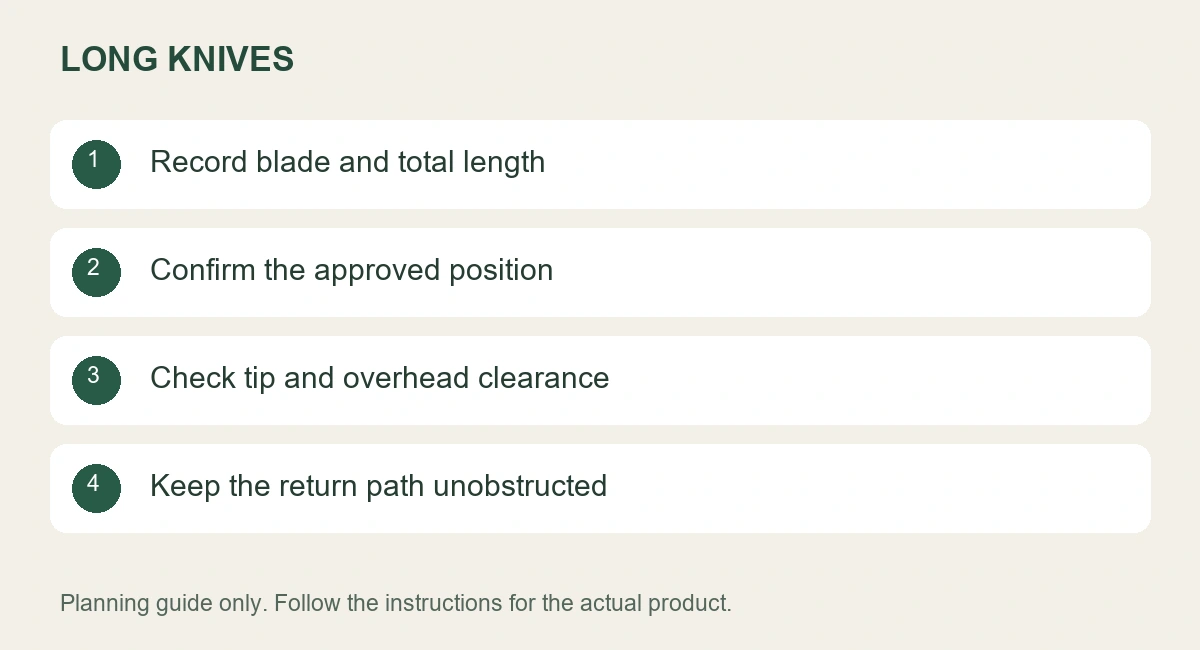
Illustrated planning checklist; follow model-specific instructions.
Account for the surrounding kitchen
A long knife can create an access issue below cabinets even when it fits the storage face. Measure overhead obstructions and check the manufacturer’s placement and removal instructions. Include the handle, not only the blade, in your planning.
Keep the proposed location away from routes where a large pan or chopping board routinely passes. A long handle extending into a busy work area can make an otherwise tidy arrangement inconvenient.
Avoid using an angled position as a workaround
Do not place a knife diagonally merely to gain apparent tip clearance unless that position is approved for the model. It may occupy neighbouring storage areas or change the intended attachment geometry.
If the knife cannot fit in the intended position, select a different suitable holder or retain appropriate protected storage for that knife. You do not need to replace the storage of the entire collection to accommodate one occasional-use tool.
Questions to send the supplier
- Is this knife model compatible with the holder?
- What is the usable height at the intended position?
- Will the tip remain clear of the base and counter?
- What removal movement and surrounding clearance are required?
Distinguish blade length from total knife length
Keep the manufacturer’s dimensions alongside the exact model name when comparing holders. Similar-looking bread knives from the same range may come in different lengths. If the model is no longer listed, ask the knife manufacturer how to identify it rather than relying on a photograph of a current version. An accurate description helps the holder supplier answer a specific fit question without treating a general category as a precise measurement.
Listings may describe a knife by its blade length, while the complete knife includes the handle as well. For tip clearance, the blade’s position on the holder is important. For cabinet access, the total arrangement including the handle matters. Keep both measurements in your notes so a familiar size label does not obscure the actual space required.
The geometry of the holder can also change how these dimensions relate. An angled face, raised base or guard may affect the intended position. Ask the supplier to show the knife in that position rather than calculating clearance from overall height alone. A diagram that identifies the usable face is more useful than a decorative dimension line across the complete product.
Compare a bread knife and a slicer separately
Two knives with similar blade lengths can differ in width, handle shape and intended contact. A narrow slicer should not be assumed to fit exactly like a taller bread knife. Check each actual model, especially when a handle or bolster changes how the blade lies against the storage face.
The task the knife performs in the kitchen does not establish its storage compatibility. Words such as bread, carving or slicing identify uses, but the holder needs to suit the physical knife. Send model information when asking about fit rather than relying only on the category name.
Examine where a long handle would sit
With a suitable resting position established, consider the handle’s relationship to cabinet doors, appliance controls and nearby storage. A handle should not project into a route where you regularly move a pan or place groceries. The issue is especially relevant on a shallow counter where the holder may already occupy much of the available depth.
Use a paper outline of the proposed arrangement to assess the location while the real knife remains protected. Check the space during an ordinary cooking task, not just with the counter cleared for inspection. The working kitchen is the environment the storage system needs to serve.
Keep the return movement in view
Removing a long knife is only half of the action. You should also be able to see and reach its intended storage position when returning it. A cabinet, guard or neighbouring knife can make placement more awkward than retrieval. Follow the maker’s instructions and avoid manoeuvring the blade around obstacles to reach an otherwise inaccessible spot.
If you need to move another knife each time, revise the layout. A designated position for the long knife should remain usable without a sequence of temporary relocations. Consider reducing the number of stored knives or using another suitable protected location for the long blade.
Decide whether everyday display is useful
A bread knife used each morning may deserve an easily accessible position. A long slicer used a few times a year may be better accommodated separately if displaying it requires an oversized block. This is a space decision, not a statement that occasional knives need less protection. Every storage arrangement still needs to fit the knife and allow suitable handling.
Before buying a larger holder, compare its complete footprint with the benefit of keeping the long blade alongside the daily collection. The additional width or height may change cabinet access and preparation space. It may also solve the problem well; the important step is evaluating those changes before ordering.
What should a demonstration show?
Ask for the knife model or dimensions, its approved resting position, the entire base and the normal placement and removal movement. A photograph cropped above the tip cannot establish tip clearance. A demonstration with a much shorter knife cannot answer the same question for your long blade.
Can a guard make an otherwise short holder suitable?
A guard does not create additional usable blade height by itself. Its purpose and permitted knife sizes depend on the design. Check the space inside the guard, the intended knife position and the removal instructions together rather than treating the guard as a universal answer to length or access problems.
Do serrations change the space needed?
The overall blade shape, length and intended contact position are the practical details to check. Do not use the serrated edge as a contact point against the base to make the knife appear to fit.
Can the longest knife go on the back?
Only if that face is suitable and accessible. Moving a fit problem out of view does not resolve it. For related layout measurements, see what size magnetic knife holder you need.