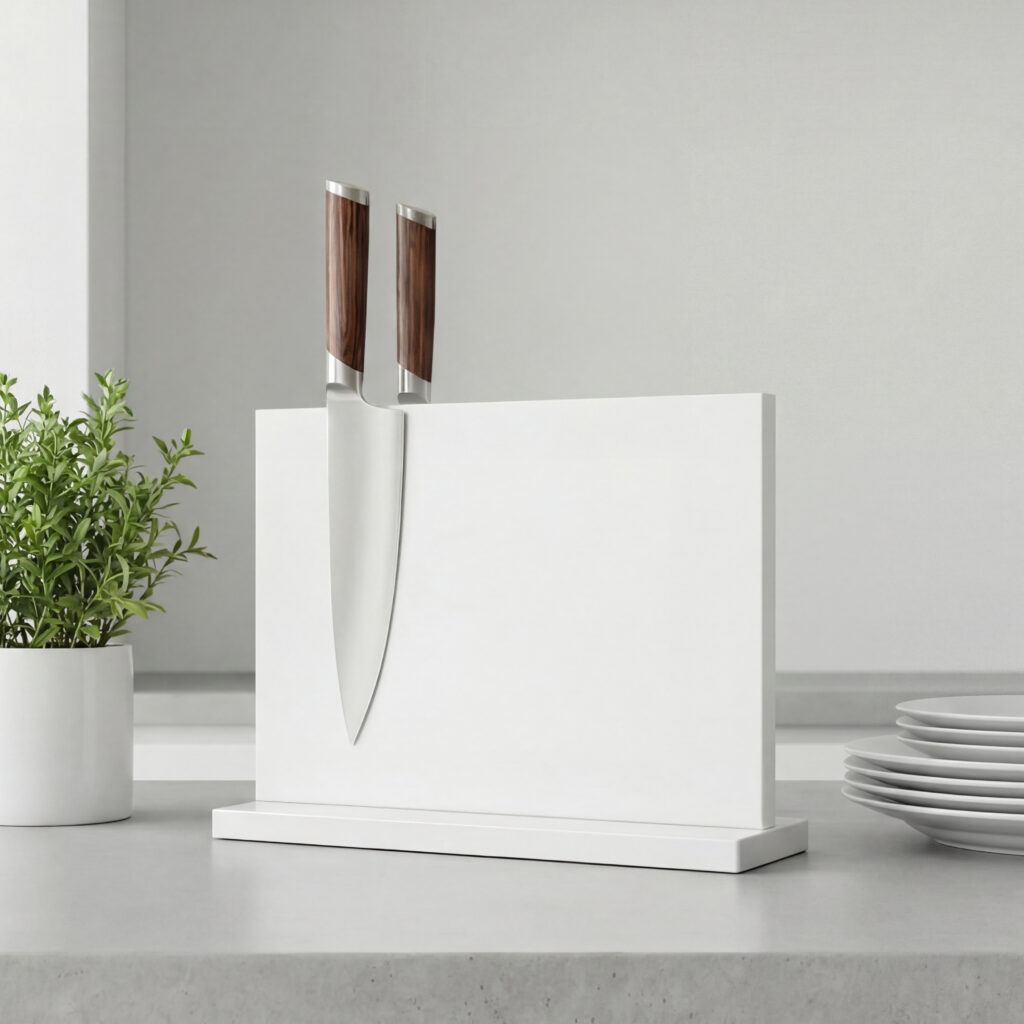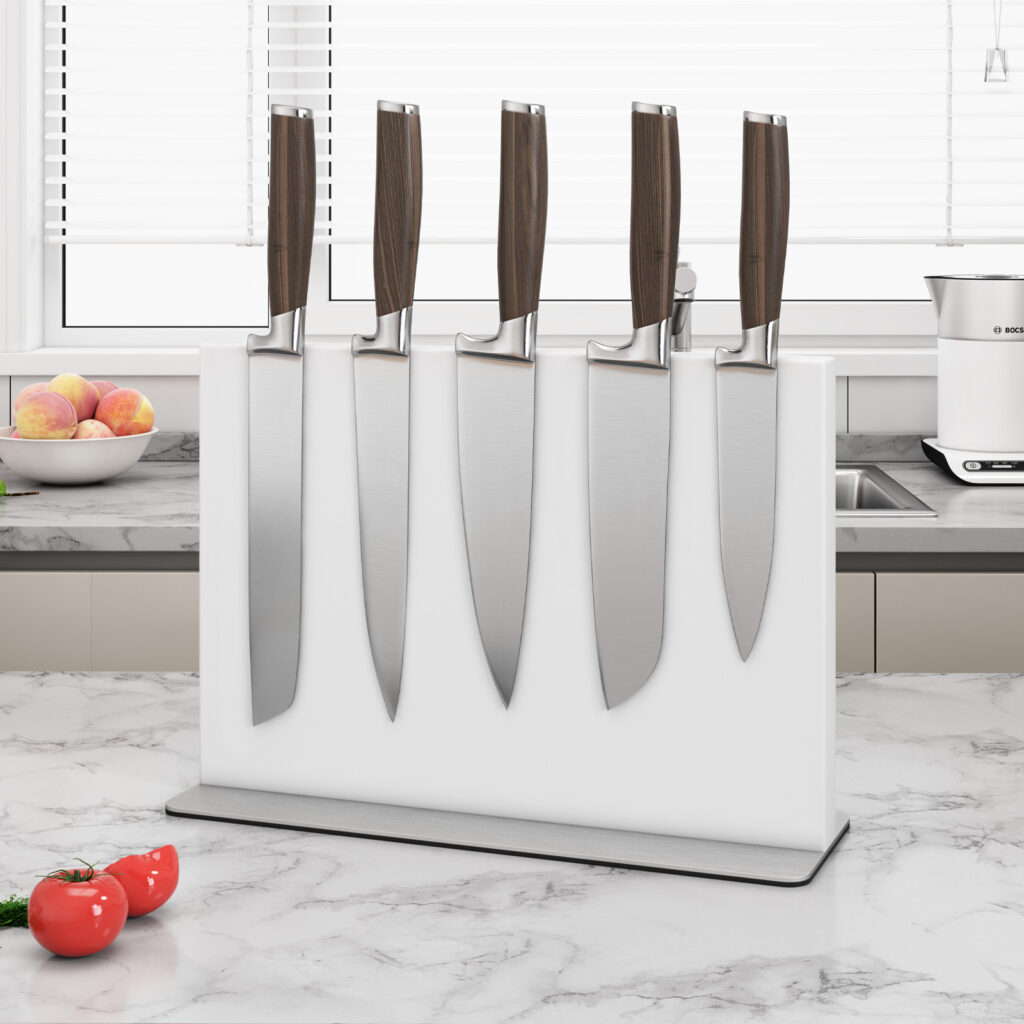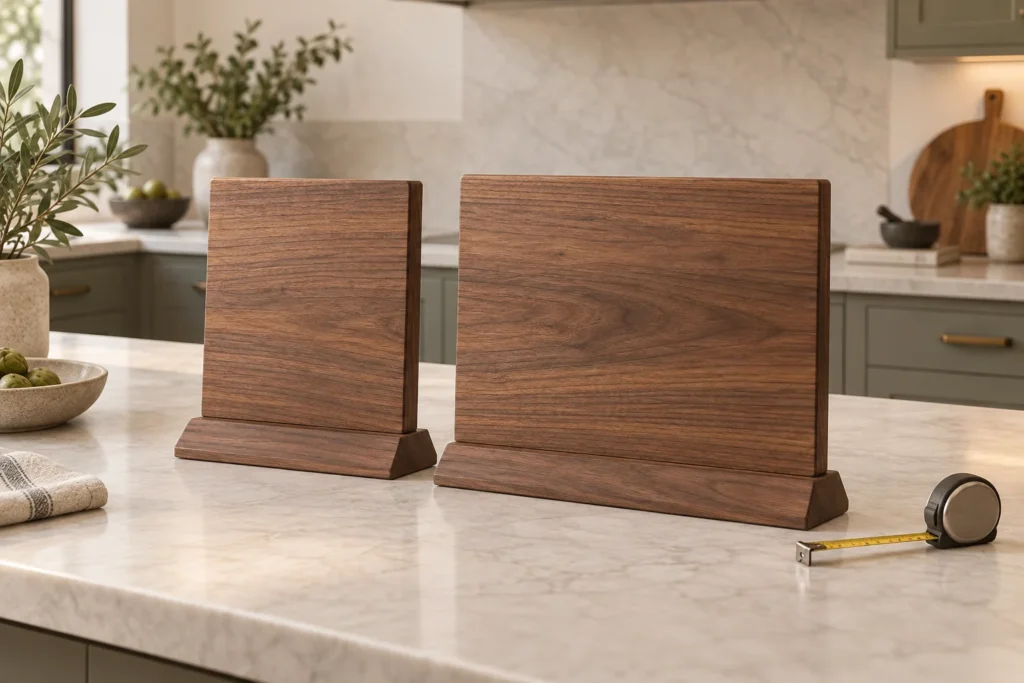
AI-generated concept illustration; not a THMINS product photograph, installation diagram or performance test.
A double sided magnetic knife holder provides two potential storage faces. Whether both are useful depends on where the block sits and how you reach the handles. A second face close to a backsplash may add little practical capacity.
Start with access rather than knife count
Mark the complete base footprint on the counter. Identify where you normally stand and whether you can reach each face without leaning across other blades. Include the space used by a chopping board, nearby appliance and the second person who may be cooking with you.
Do not count a rear position as everyday storage if using it requires lifting, turning or sliding a loaded holder each time. Ask whether one-sided use is suitable for the model if that is the only accessible arrangement.
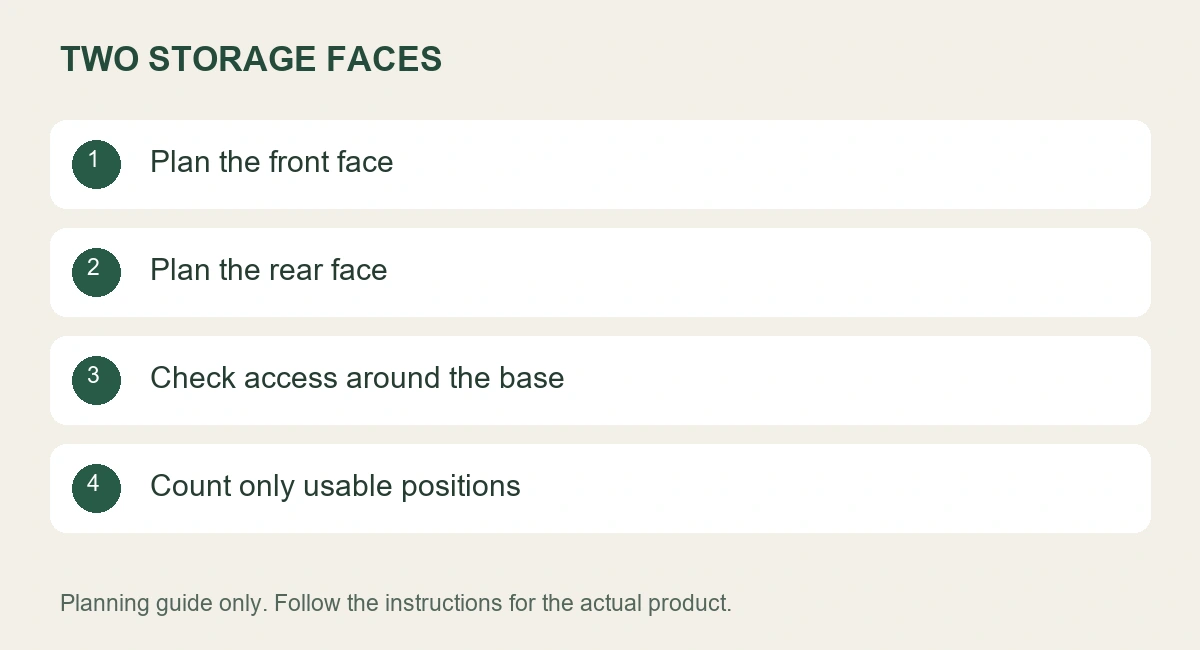
Illustrated planning checklist; follow model-specific instructions.
Give each handle a clear route
Two faces do not eliminate spacing requirements. Wide blades and large handles can still crowd neighbouring knives on the same face. Plan each face independently, then examine access around the complete block.
A diagram made from knife dimensions can help you compare arrangements. It is a planning aid, not a test of attachment performance. Confirm the proposed knife types and placement with the holder’s instructions.
Decide who uses each side
On a kitchen island, two cooks may approach from different directions. Agree where commonly used knives belong so neither person reaches across the other’s work area. Consider whether the outward-facing side is exposed to visitors or household traffic.
| Location | Main question |
|---|---|
| Against a backsplash | Is there enough space to access the rear face? |
| On an island | Who can approach the exposed side? |
| Beside an appliance | Does normal appliance use obstruct a handle? |
Keep cleaning access in the layout
Leave enough room to remove the knives and clean the holder and surrounding counter as instructed. A layout that looks efficient while loaded may become inconvenient if the whole arrangement must be dismantled for routine wiping.
Draw two layouts before choosing the larger model
When comparing supplier photographs, check whether the rear face is actually shown or merely described. A three-quarter view may hide the clearance behind the holder. Request a separate rear view and the usable dimensions for that face. If the two faces differ in construction or intended use, record that distinction in your sketch instead of assuming the front layout can simply be copied onto the back.
Sketch the front and rear faces separately, using the usable dimensions supplied for the model. Assign the intended knives to each face and allow for their widest blades and handles. Then draw the complete base in the kitchen location and mark where a person would stand to use each face. The face drawings describe storage; the location drawing describes access. Both are needed to evaluate the arrangement.
This exercise can show that a wider single accessible face is more useful than two crowded faces, or that a double sided holder genuinely suits an open preparation area. It can also show that only some of the rear positions would be practical. Count the positions you expect to use comfortably rather than every position visible in the product listing.
Separate occasional storage from everyday access
It may be tempting to put rarely used knives at the back and accept awkward access because they are retrieved less often. Occasional use still requires a suitable removal path. A knife that is difficult to reach does not become well stored merely because the problem occurs only a few times a year. Consider a separate protected location for that item if the rear face cannot be accessed as intended.
For everyday knives, prioritise a clear and predictable handle position. If two household members use the block, agree on the layout rather than allowing knives to migrate between faces. This makes the arrangement easier to understand and avoids reaching around the block to search for a missing knife.
Consider the exposed side of an island
On an island, the face away from the cook may point toward seating or a walkway. Evaluate who uses that area and how close they come during ordinary activity. A two-sided display can change the access pattern compared with a block against a wall. Where exposed blades are unsuitable, choose another location or protected storage with appropriate access controls.
Check nearby chairs, bags and items placed on the island as well. The holder should not become part of a landing area for shopping or school items. A dedicated preparation zone is easier to maintain than a surface that alternates between knife storage and general household storage throughout the day.
Ask about loading instructions instead of inventing a balance rule
Do not infer that the two faces must contain an identical number of knives or that a particular side must be loaded first. Those details belong to the model’s instructions. Knife weights, base construction and intended placement can differ, so a rule based only on visual symmetry is not a reliable substitute.
If the instructions do not address the arrangement you want, describe it to the supplier. Identify the knives and the proposed positions. Ask whether one-sided use, mixed knife sizes or leaving one face empty is appropriate. Obtain clarification before using a configuration that the product information does not explain.
Plan the emptying and cleaning sequence
Choose protected temporary storage before removing knives for cleaning. Empty the holder using its recommended handling method, then clean the accessible surfaces and surrounding counter according to the care instructions. Do not rotate or carry a loaded block simply to wipe an inaccessible area behind it.
If routine cleaning requires repeatedly relocating other appliances, reconsider the footprint. A slightly less crowded arrangement can be easier to maintain even if it appears to use more space. Practical storage includes access for care as well as access for cooking.
Can I rotate the holder to use the back?
Only use a rotating feature when the product is designed for it and the instructions explain operation with knives present. A fixed-base block should not be treated as a rotating stand. If turning or moving it is necessary for ordinary retrieval, another location or storage arrangement may serve the collection better.
What image should I request before ordering?
Ask for a view of both faces with the specific knife sizes identified, plus a view showing the entire base. A front-only photograph cannot explain rear access, and a tightly framed blade photograph cannot show how the complete holder occupies the counter.
Does double sided mean twice the capacity?
Not necessarily. Capacity depends on usable attachment areas, knife shapes and accessible positions. Ask for an example layout identifying the knives rather than assuming a simple doubling rule.
Should both sides carry equal numbers of knives?
Follow the manufacturer’s loading and placement instructions. A matching count does not establish an appropriate arrangement because knives differ in size and weight.
Before choosing a model, combine these access checks with the countertop buying checklist.