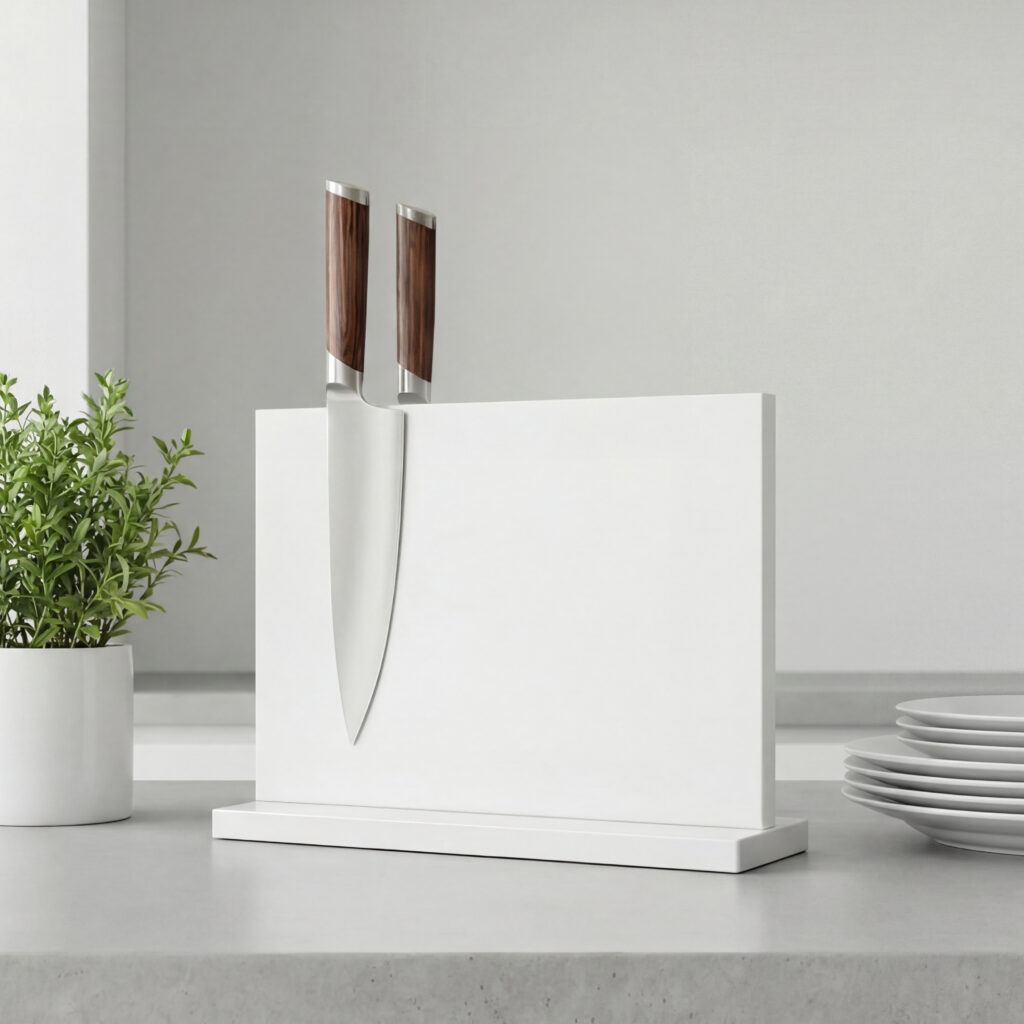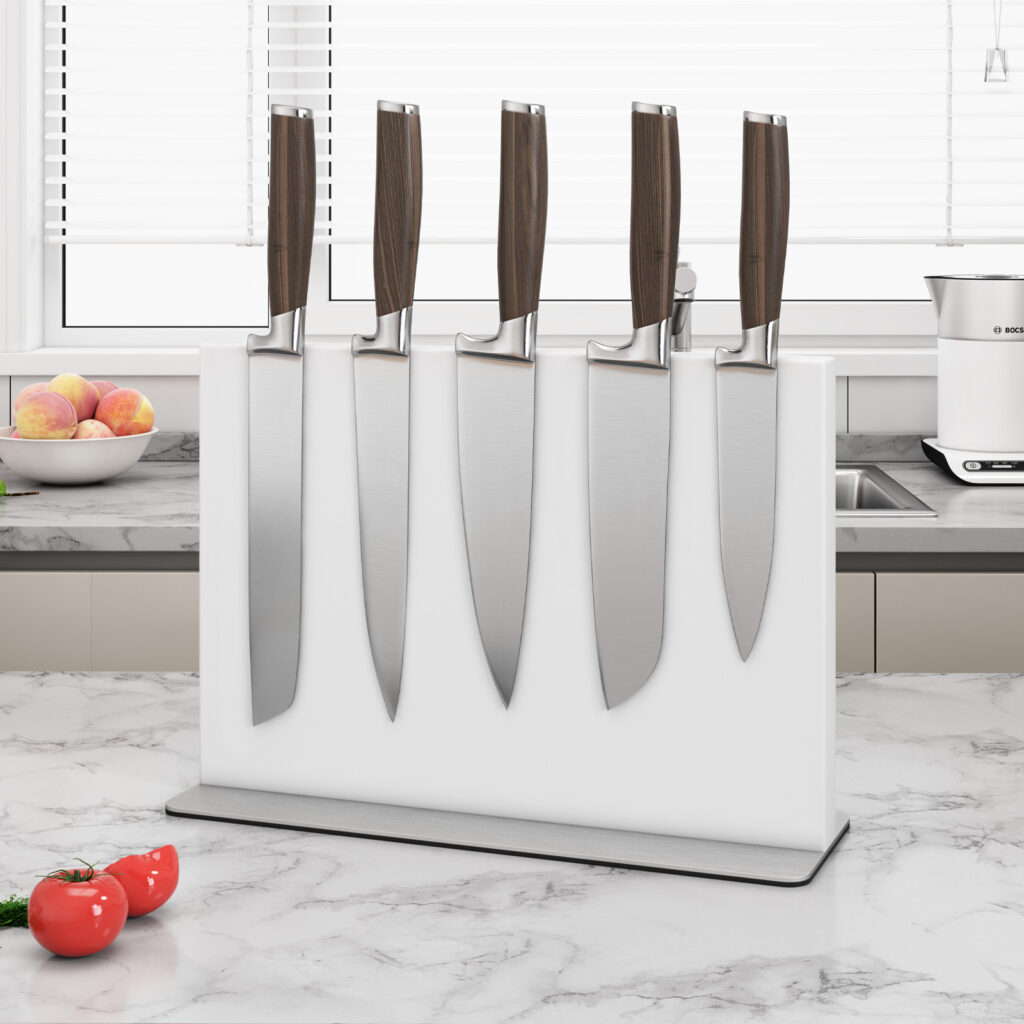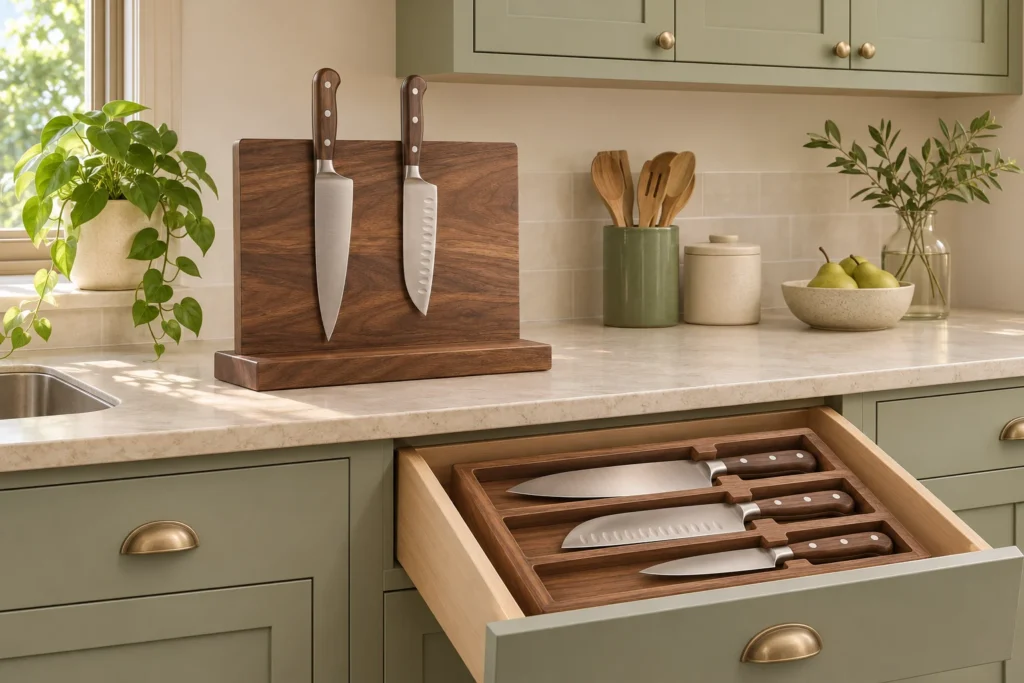
AI-generated concept illustration; not a THMINS product photograph, installation diagram or performance test.
A magnetic knife holder can fit beneath a wall cabinet while still being awkward to use there. Overall height tells you whether the block fits into the space. It does not tell you whether a knife can be removed comfortably in the way the manufacturer recommends.
Measure the lowest obstruction
Measure from the counter to the lowest nearby cabinet feature, including lighting, trim and projecting fittings. Then record the holder’s overall height and the position of the tallest stored handle. Use actual dimensions rather than estimating from a product photograph.
Keep the knives safely stored while planning. A paper outline or an empty holder is enough to examine the location without moving exposed blades around a cramped area.
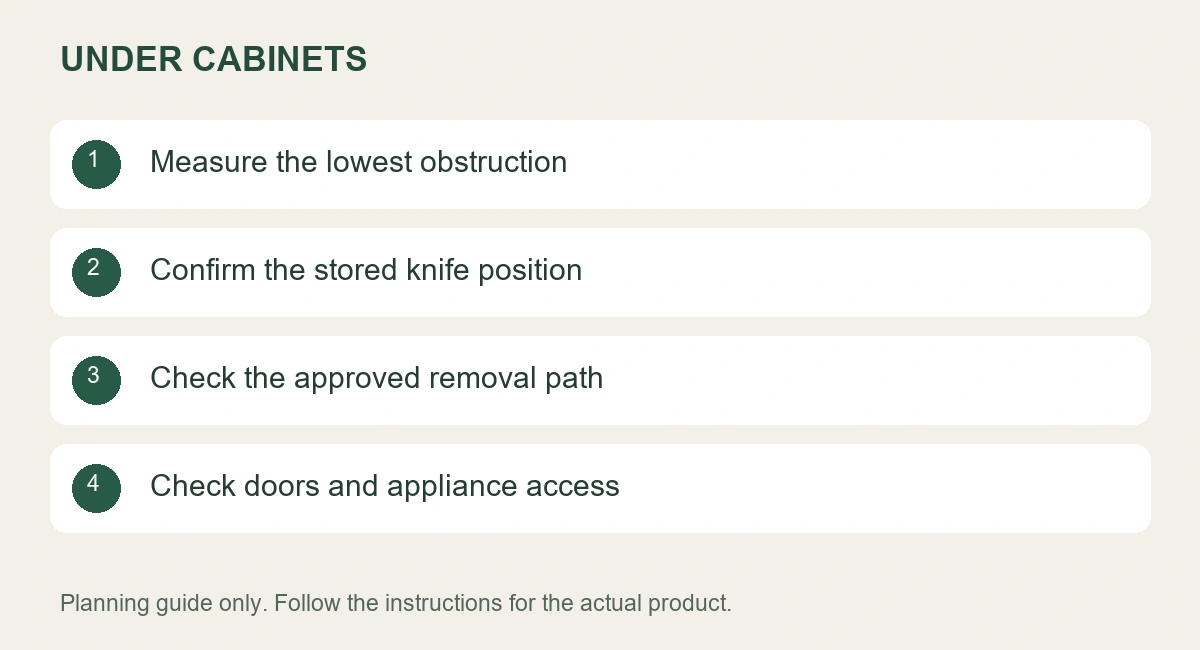
Illustrated planning checklist; follow model-specific instructions.
Confirm the removal path
Some designs include a guard or other feature that affects how a knife is placed and removed. Ask for the recommended movement for the exact model. Do not assume a straight upward lift or a forward pull is suitable for every holder.
The required clearance depends on the knife, holder and movement together. A universal instruction such as “leave a few extra centimetres” cannot replace checking that combination.
Check doors and daily activity
Open adjacent cabinet doors with the proposed holder footprint marked on the counter. Check whether anyone reaching for a mug would pass their hand close to the stored knives. Look at appliance cords and the route used to move a chopping board or drying rack.
| Check | What you want to establish |
|---|---|
| Overhead space | The knife can follow its approved removal path |
| Cabinet door swing | The door does not contact the holder or handles |
| Counter depth | The complete base sits properly on the surface |
| Rear clearance | Any rear storage face remains accessible |
Change the location before forcing the fit
If normal access is restricted, consider a different counter position or a protected drawer solution. Do not tilt the holder, balance its feet on a spacer or alter a fixed guard to make it fit. Those changes can affect how the product is intended to work.
Use a simple clearance worksheet
Keep the worksheet with the product information after purchasing. If you later add a taller knife or replace an appliance beside the holder, the recorded measurements give you a useful starting point for reassessment. Check the new arrangement directly rather than assuming that the earlier clearance decision still applies. A kitchen can become more crowded through small changes even when the holder itself has not moved.
Record three groups of information separately. The first describes the kitchen: counter depth, distance to the lowest cabinet obstruction and nearby door swings. The second describes the holder: complete height, base dimensions and the location of any guard. The third describes the knife: blade length, handle dimensions and the intended storage position. Keeping these groups separate prevents an overall product measurement from being mistaken for usable clearance.
Send the worksheet to the supplier if a dimension or movement remains unclear. A useful question might explain that the block would sit below a cabinet with an under-cabinet light and that you intend to store a named long knife. Ask for the required removal space for that combination. This is more informative than asking only whether the block fits under cabinets.
Examine the lowest stored and highest moving positions
A knife has a resting position and a path it follows during removal. Both need to be suitable. At rest, the tip should clear the base in the intended arrangement. During movement, the handle and blade should not encounter cabinetry or lighting. Do not solve one clearance problem by introducing another, such as placing a blade too high on a storage face without the manufacturer’s approval.
The same reasoning applies when returning the knife. It should be possible to see the intended position and place the knife without manoeuvring around an obstruction. If overhead cabinetry hides the contact area or forces an awkward approach, consider a different location even if removal alone appears possible.
Keep cabinet contents in the assessment
Think about what is stored above the proposed holder. A cupboard containing everyday mugs may be opened repeatedly while someone else prepares food below. A cupboard used only occasionally creates a different pattern of movement. The question is not simply whether the door clears the block, but whether normal retrieval from the cupboard brings hands, objects or sleeves close to the knives.
Avoid making access depend on an informal rule that nobody reaches into that cabinet while cooking. A clearer layout is preferable where space permits. Moving frequently used cabinet contents or choosing another holder location may resolve the conflict without changing the holder itself.
Compare alternative positions with the same checklist
If the first location fails, evaluate another using the same worksheet. A clear stretch of counter beside the cabinet may provide easier access but expose the block to a passing route. An island may remove the overhead obstruction but introduce access from several sides. Every location has its own conditions, so changing the location should trigger a complete check rather than just a height check.
Where there is no suitable counter position, a protected drawer arrangement may be more practical. This is particularly relevant when the kitchen’s only clear counter area is needed for food preparation. Choosing storage that suits the available space is more useful than squeezing a preferred display into an awkward corner.
Keep photographs useful when asking for help
Photograph the empty proposed location with a measuring tape or clearly described dimensions. Show the overhead cabinet, light fittings, counter edge and nearby appliance. Avoid including personal items or household information that is unrelated to the product question. A wide view communicates the access problem better than a close-up of a single measurement.
Pair that image with the exact holder model and knife details. The supplier can then explain which dimensions are relevant and whether a demonstration is available. A response based on another model should not be assumed to apply when guards, angles or base designs differ.
Is a taller cabinet gap always sufficient?
More room can help, but the actual removal path and nearby obstacles still matter. A generous vertical gap does not resolve a narrow approach between appliances. Evaluate height, depth and hand access together, and follow the instructions for the product rather than using one measurement as a universal pass condition.
Can I move the holder forward whenever I need a knife?
A permanent location with clear access is more practical than repeatedly repositioning a loaded block. If it must be moved, follow the maker’s instructions and remove knives before handling the holder where required.
Should I choose a shorter holder?
Only if it still accommodates the intended knives with appropriate tip clearance. Reducing overall height can create a separate blade-fit problem. Check both dimensions with the size selection guide.