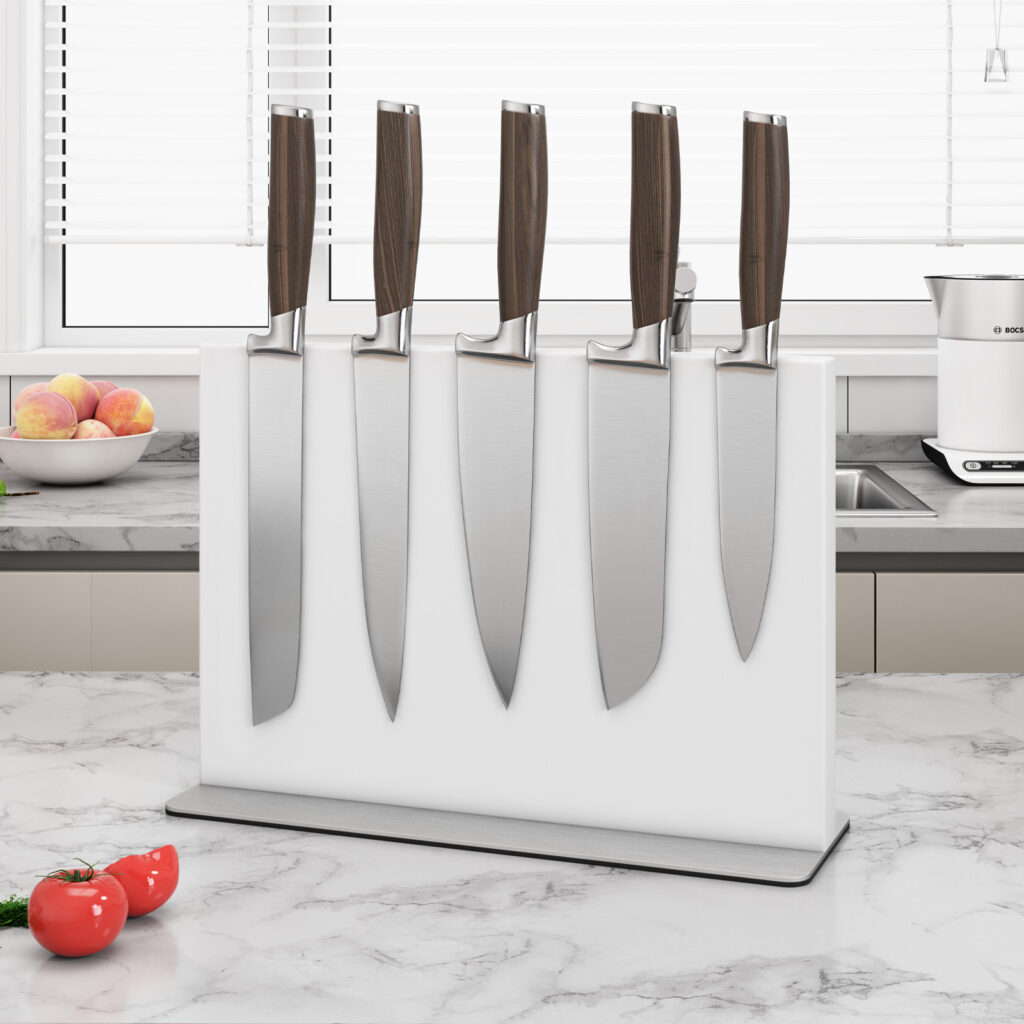
This article is published by THMINS and includes a link to our own product on Amazon. As an Amazon Associate, we earn from qualifying purchases.
Read the variant and situation behind each opinion. AI-generated concept scene; the laptop does not display real Amazon reviews.
The most useful magnetic knife block review is not necessarily the longest or the most enthusiastic. It is the one that describes a relevant product variant, a recognizable use situation, and an outcome you can compare with your own kitchen. Start there rather than treating the average star rating as a complete buying recommendation.
This is especially important on listings that combine several sizes or storage styles. A favorable comment about a wall-mounted strip may appear beside a countertop block, while a complaint may concern a different base or finish. Read the details below the review title before deciding whether the experience applies to the item in your cart. A few minutes of careful sorting can turn a confusing collection of opinions into useful questions for the seller.
First identify which product the reviewer received
Write down the selected variant’s name, dimensions as listed, and ASIN before opening the reviews. Then check the variant label attached to each relevant comment. The product title at the top of the review page does not necessarily mean every review below it concerns that exact configuration.
In our reading of an imarku review page, a five-star comment about easy installation carried a 15.94-by-2.60-by-0.91-inch variant label and linked to a different ASIN from the countertop block. That entry was excluded from the countertop buying evidence. Its presence does not make the review improper; it means the shopper needs to match the experience to the product type. Different-variant example.
When a variant label is absent, do not fill the gap from the current product image. The reviewer may be discussing a different option or an older configuration. Keep that account separate until the product can be identified. This is particularly useful when the text describes slots, mounting, or another feature that does not match the selected magnetic block.
Read positive and negative comments for different reasons
Four- and five-star comments help identify what buyers value: seeing their knives, enjoying the appearance, or keeping frequently used tools organized. One- and two-star comments can reveal where expectations fail, such as assembly, surface condition, or access with a particular knife. Neither group should be read as a complete description of the product.
Look inside positive reviews for reservations. A four-star imarku buyer appreciated the convenient sharpener but wondered whether the magnet would weaken over time. The comment expressed a future concern, not an observed loss of holding strength. Turning that question into a claim that the magnets had weakened would misrepresent what the reviewer wrote. Concern within a positive review.
Likewise, a low rating can contain useful praise. A HOSHANHO buyer liked aspects of the materials and magnets but could not assemble the pieces. That is a more specific problem than saying every aspect of the holder was poor. Preserve the distinction when deciding what needs further investigation. Assembly-related account.
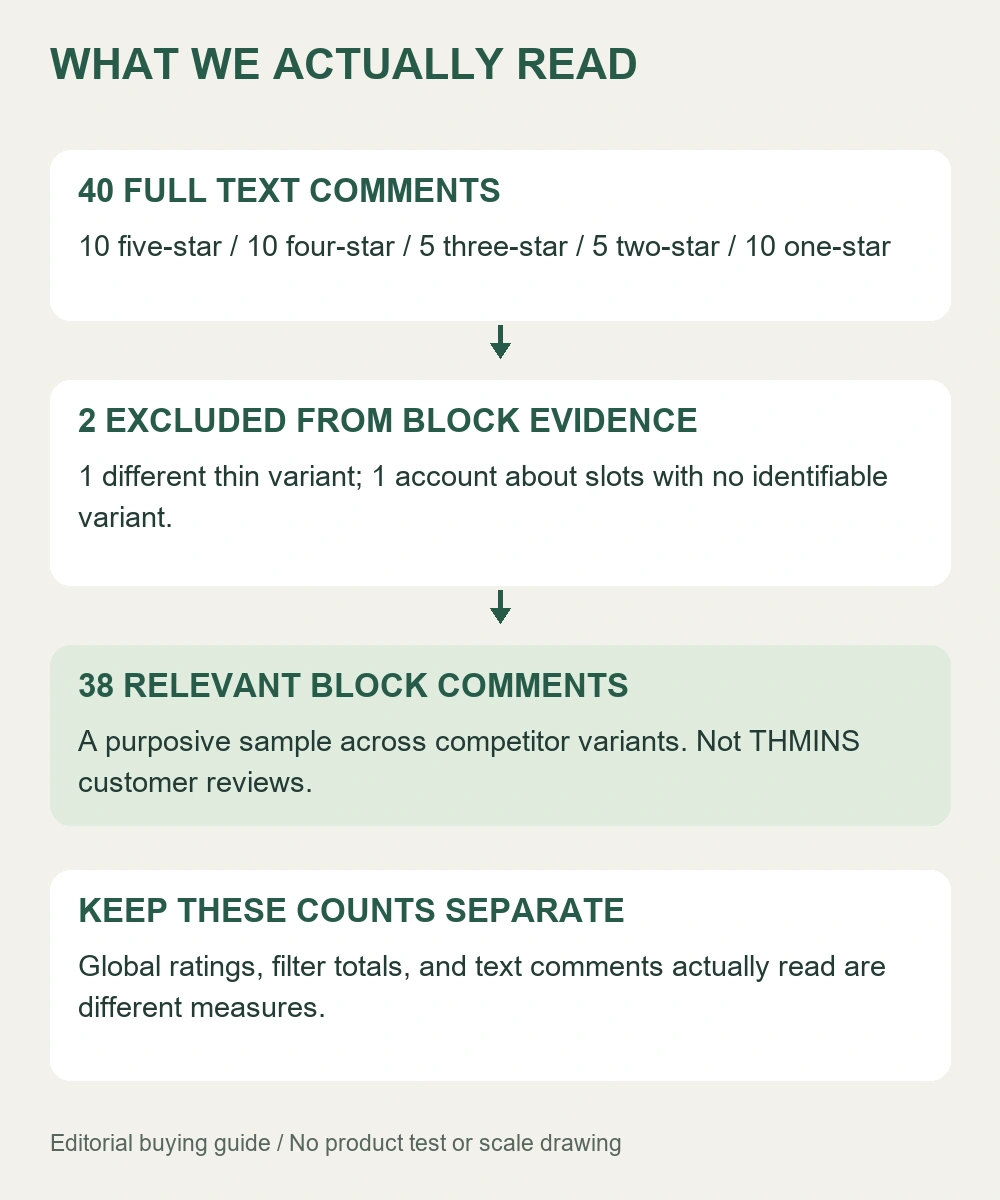
This is the evidence sample used for these five guides, not a defect-rate estimate or the listing’s rating distribution.
Separate the observation from the explanation
A reviewer may accurately report a visible mark while guessing why it appeared. They may describe a knife moving and then infer how the magnets are arranged inside the block. The observed event and the proposed cause are different kinds of information. You can take the experience seriously without adopting an explanation that has not been verified.
For example, “the base moved when I removed my chef’s knife” raises a useful question about that combination and removal method. It does not by itself establish the internal design, the magnet grade, or whether every unit behaves that way. Ask for the knife type, variant, and ordinary setup conditions where those details are available.
Be equally careful with praise. “Very strong” is a buyer’s impression unless it accompanies a defined measurement with relevant conditions. It is not a capacity specification for your knives. Positive and negative descriptions become more useful when you retain what was actually observed and leave unsupported causes or universal conclusions out of the comparison.
Treat review labels as context, not a verdict
Record whether the page labels a comment Verified Purchase or Vine. Those labels help you understand the review’s context, but they do not make its conclusion automatically applicable to your kitchen. A verified buyer can use a different knife collection, and a Vine reviewer can still describe a relevant practical limitation.
In the ten four-star imarku comments we read, three were labeled Verified Purchase and seven were labeled Vine. That composition describes this particular sample, not the whole listing or all customers. Keeping the labels attached to the comments prevents a small selected group from being presented as an undifferentiated body of buyer experience.
The content still matters. A detailed account that identifies the variant and explains the situation may help you ask a useful question, regardless of whether you agree with the reviewer’s preference. A short statement such as “love it” tells you the person was pleased but gives little guidance about whether your longest knife or preferred layout will work.
Do not turn the rating chart into a failure rate
During our reading, the HOSHANHO page displayed 4.7 out of 5 from 3,006 global ratings. The selected critical filter reported 220 matching customer reviews, but we read only the ten visible entries on that page before separately reading ten one-star entries. Those are different quantities: an overall rating total, a filter’s reported count, and the text actually examined.
The global figures may cover pooled variants, and the review sample is deliberately selected by rating. It cannot tell us what percentage of delivered blocks have a particular problem. Ten low-star accounts are useful for identifying questions; they are not a random sample from which to calculate a defect rate. The same limitation applies to a handpicked group of glowing reviews.
Also distinguish platform-generated summaries from individual comments. A summary can help locate topics, but it is not another buyer and should not be counted as a text review. Follow a topic back to the actual comments and inspect the product variants before relying on it for a purchase decision.
Turn each relevant comment into a question
Use a simple note with four fields: the product variant, the reported situation, the outcome, and the question it creates for you. A report about uneven feet becomes a question about the intended base contact and replacement parts. A complaint about a logo becomes a request for a clear current photograph. A comment about a particular long knife becomes a compatibility inquiry using your knife’s model.
This approach is more productive than collecting dramatic adjectives. It also helps you notice when two apparently conflicting reviews describe different conditions. One owner may be delighted with small everyday knives while another struggles with a different collection. You do not have to decide that one person is wrong to recognize that their situations differ.
Keep the questions short when contacting the seller. Include the exact selected listing and the details relevant to your concern. Ask for specifications, instructions, or photographs that can resolve the uncertainty. A general reassurance about quality is less helpful than an answer addressing the actual scenario.
Compare THMINS using its own verified details
Competitor reviews can help you discover what to check, but they do not prove how a THMINS magnetic knife block performs. Keep product-specific praise and criticism attached to the brand and variant that received them. Do not transfer a competitor’s dimensions, accessory list, or reported problem to a THMINS listing.
When you are ready to compare a THMINS option, open the current product information at View the THMINS magnetic knife block on Amazon. Match the selected variant to your requirements and use your review notes to resolve unanswered questions. The goal is a purchase supported by relevant details, not a decision based on whichever star rating or dramatic comment you happened to read first.
Editorial evidence note: Review pages were read on November 17, 2026 (China time). Comments were selected by star rating and may concern different variants. They identify buying questions, not population-wide outcomes. Illustrations are concepts, not product photographs or test evidence.