This article is published by THMINS and includes a link to our own product on Amazon. As an Amazon Associate, we earn from qualifying purchases.
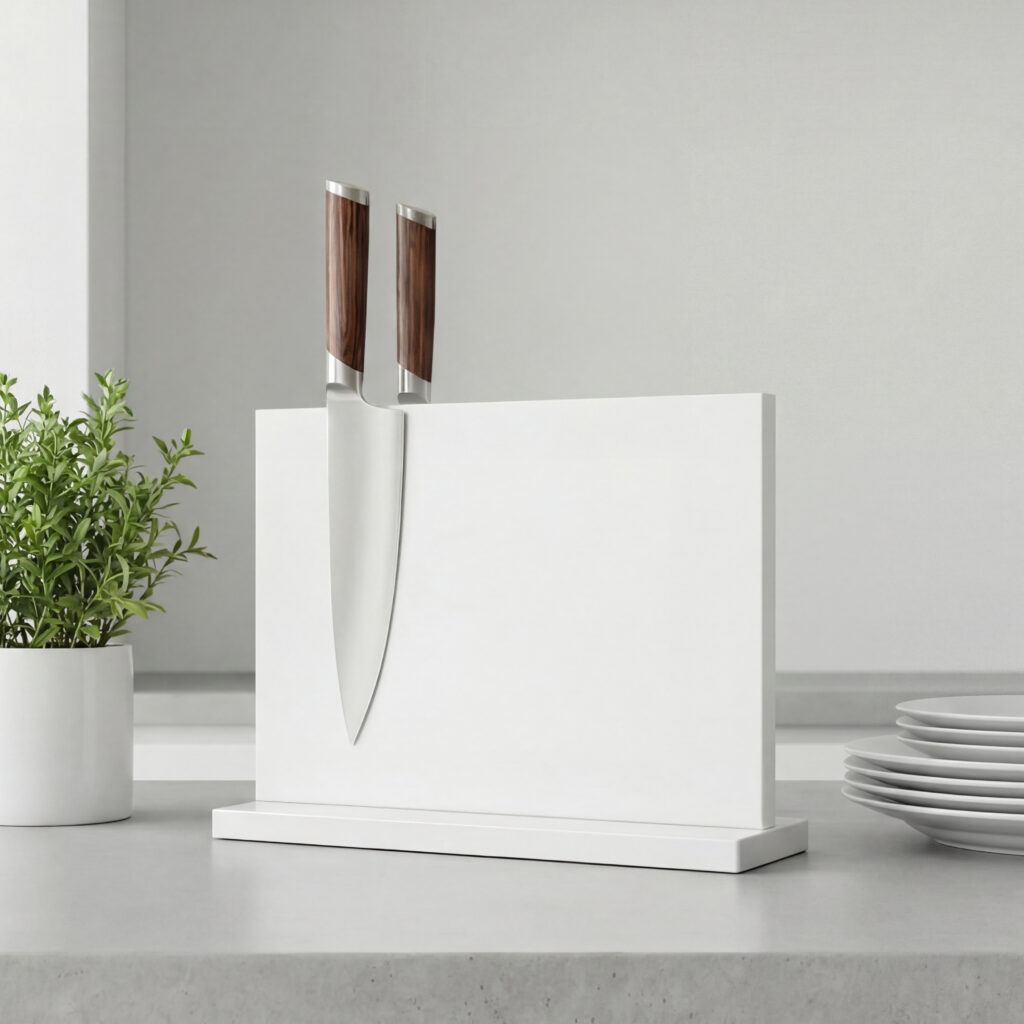
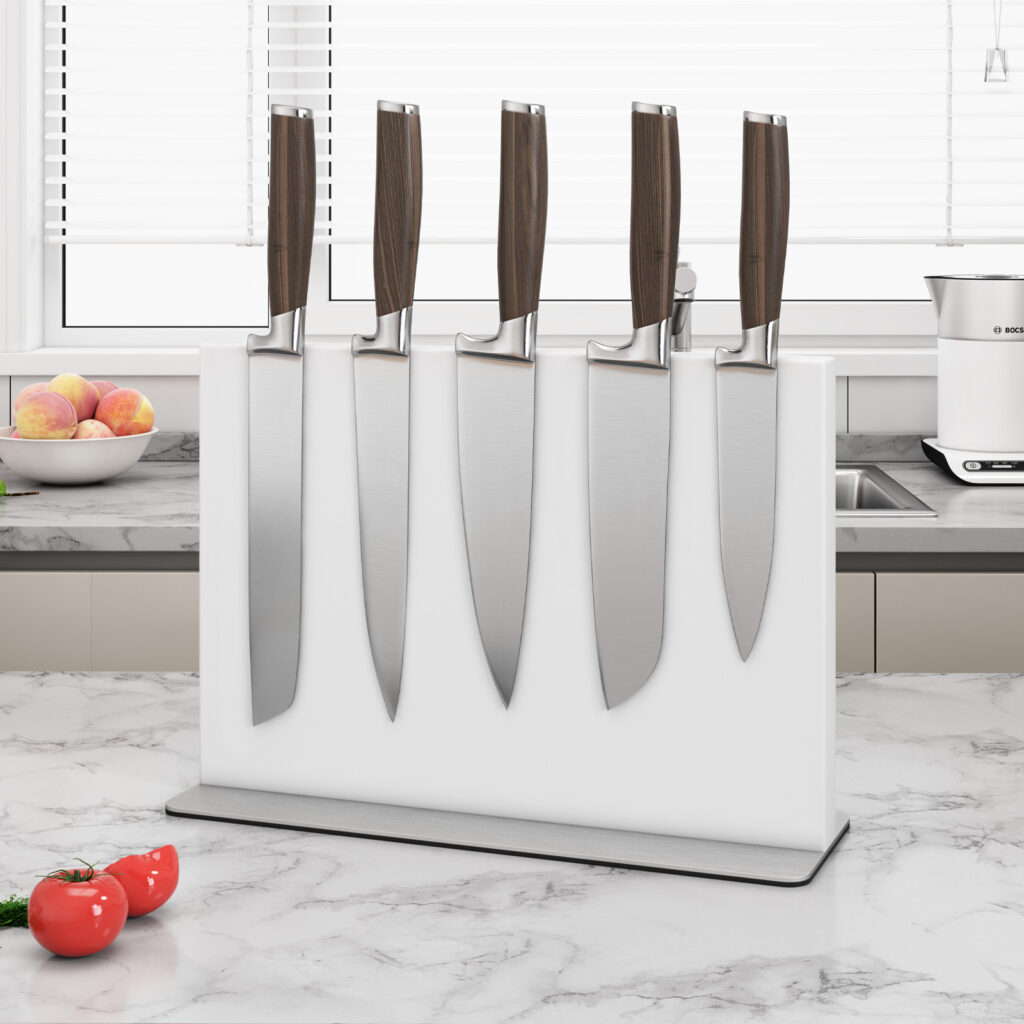
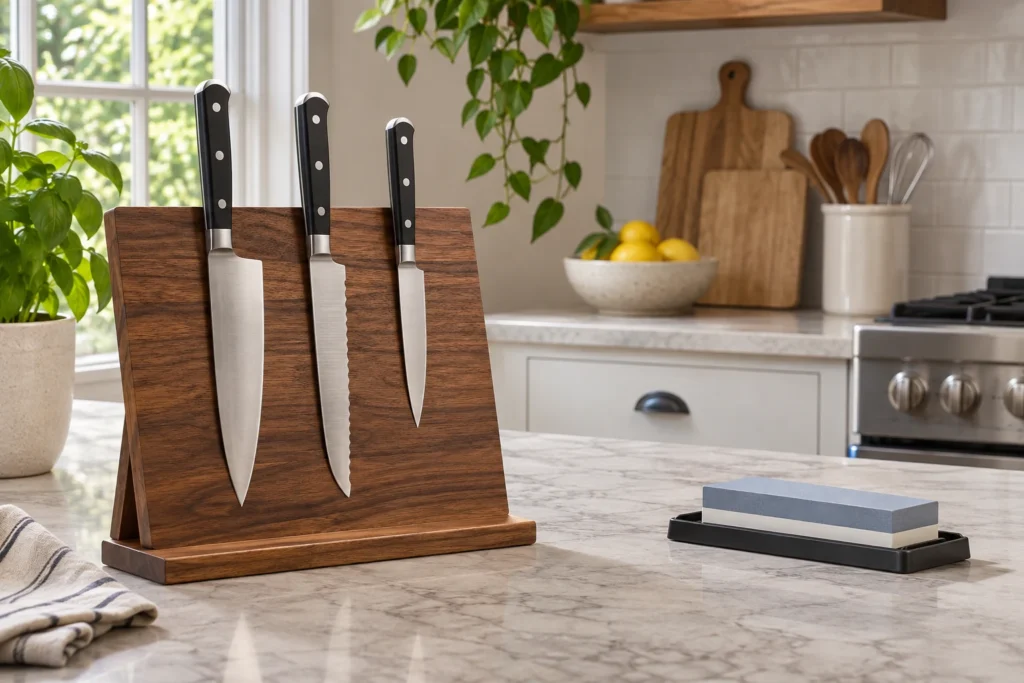
Storage and sharpening are separate buying decisions. AI-generated, unbranded concept scene; not a THMINS product photo or test.
A magnetic knife block with a built-in sharpener promises an appealing arrangement: the knives you use every evening and a maintenance tool live in one place. That can sound especially useful when a drawer already holds too many small accessories. Before paying for the combination, however, ask whether the sharpener suits your knives and whether you would actually use it. A storage feature and a sharpening feature deserve separate buying decisions.
The right answer is sometimes yes. A clearly documented, compatible sharpener may fit an established routine. In other kitchens, a plain magnetic block plus the sharpening method the owner already trusts is the better purchase. The extra feature earns its place through compatibility and convenience, not merely by appearing in a product title.
What the buyer comments actually tell us
The Amazon comments we read about imarku magnetic blocks were mixed on this detail. A verified four-star buyer of the 13.22-inch listed variant appreciated the convenient integrated sharpener. A different four-star reviewer, labeled as receiving a free product through Vine and reviewing the 12.23-inch variant, liked the block but disliked its sharpener. These are individual experiences with competitor products, not tests of THMINS equipment. Their disagreement suggests a useful question: what does the added tool contribute to your particular knife-care routine? Convenience comment, critical comment within a positive review.
Neither comment identifies a result that every buyer should expect. The products also had different listed dimensions. Rather than averaging the two opinions into a verdict, use them to identify the information missing from a shopping page: supported blade types, operating instructions, and the role of each sharpening stage.
Start with the knives, not the accessory count
Imagine a home cook whose everyday collection contains a chef’s knife, a serrated bread knife, and a small utility knife. A picture showing all three attached to a magnetic block does not establish that all three can pass through its sharpening slot. Storage compatibility and sharpening compatibility are different questions. Write down the exact knife models before comparing the accessory descriptions.
This distinction has practical support in manufacturer guidance. Kai describes one of its pull-through sharpeners as intended for particular straight-edged, double-bevel blades and explicitly excludes several other blade types, including serrated and single-bevel knives. That restriction belongs to that specific sharpener; it illustrates why the instructions matter rather than establishing the specification of an unrelated built-in unit. Kai sharpener guidance.
Ask the block seller for the sharpener’s own instructions if they are missing. A general phrase such as “for kitchen knives” is not enough to resolve a question about a particular edge. If the knife manufacturer and accessory instructions do not establish compatibility, leave that knife out of the sharpening process and seek clarification.
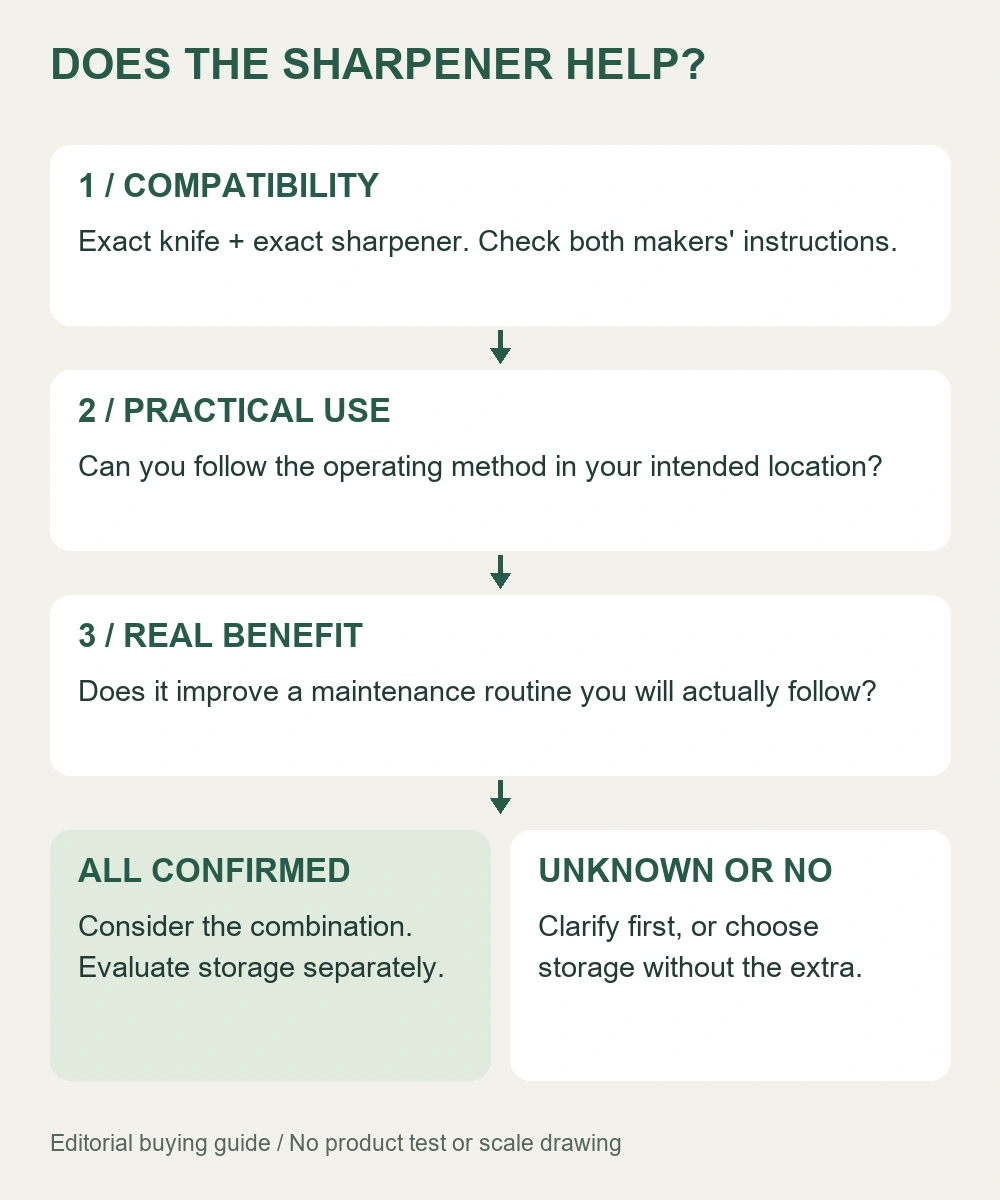
A compatibility-first decision flow; this is a buying aid, not a sharpening procedure.
Compare the feature with your existing routine
Think about the last time you maintained a knife. Did you use a tool you already own, visit a local sharpening service, or send the knife to its manufacturer? If that arrangement works well, an integrated sharpener may add very little. There is no reason to change a successful routine merely because a new storage product includes another option.
Now consider someone who has no routine at all. A built-in accessory can make the need for maintenance more visible, but visibility does not replace instructions or practice. Before choosing the combination, decide where you will learn the approved method, how you will identify compatible knives, and how you will keep the tool ready for use. Buying more functions is only helpful when those functions can be used appropriately.
Do not assume that storing a knife beside a sharpener means sharpening it every time it is returned. Frequency and technique should follow the relevant knife and tool guidance. This article is a buying guide, not a sharpening procedure, and an Amazon review is not a substitute for either manual.
Look closely at the location of the sharpener
The accessory’s position matters as much as its presence. Look for a clear picture of the complete block and instructions showing how the sharpener is used. Ask whether knives must be removed from the storage faces first, where the user’s hands belong, and how the block is supported during the operation. Do not infer those details from a close-up that crops out the base.
In a kitchen where the block sits near a backsplash, a side-mounted feature may be less accessible than it looks in a studio photograph. On an island, the same location may be easier to approach but closer to another person’s work area. Evaluate the intended setup without trying out uncertain movements around exposed blades. Missing operating guidance is a reason to ask the seller, not to improvise a technique.
Also check how the accessory is maintained and whether any consumable or replaceable part can be obtained separately. If the sharpener eventually needs attention, you should know whether that affects the storage function or simply means using another sharpening method. Do not assume that an integrated part is removable because a seam is visible in a photograph.
Give storage performance its own decision
A sharpener cannot compensate for a block that does not suit your collection. First establish that the intended knives can be stored and retrieved according to the holder’s instructions. Then evaluate the accessory. This order keeps a bonus feature from distracting you from the product’s primary purpose.
For example, a shopper may be choosing between a straightforward holder that fits three daily knives and a combination model whose advertised capacity is larger. If the shopper does not need extra positions and already owns a compatible maintenance tool, the larger feature list may bring no practical benefit. Conversely, a compatible integrated tool could be attractive when it replaces a genuinely inconvenient separate accessory. Neither conclusion requires declaring one format universally better.
Keep any comparison with THMINS equally specific. Check the current THMINS magnetic knife block listing for the selected model and included components. Do not assume that a competitor’s sharpener, material, or maintenance arrangement is included with a THMINS holder. Compare confirmed features rather than transferring details from one brand’s pictures to another.
A short message that gets a useful answer
Send the seller a focused question: “I own these knife models. Which are compatible with the included sharpener, and can you provide its operating and maintenance instructions?” Include whether any knife is serrated or has a special edge configuration according to its maker. You do not need to describe the whole kitchen before asking this first question.
If the answer is simply that the magnet is powerful, the sharpening question remains unanswered. Follow up about the accessory itself. If the seller supplies a clear manual, compare it with the knife manufacturer’s guidance. This gives you something more dependable than a broad claim that the product is multifunctional.
Buy the combination only when both parts help
Choose a magnetic knife block with a sharpener when its storage layout works, its sharpening compatibility is documented, and the added tool serves a routine you intend to follow. Choose a simpler holder when sharpening is already handled well elsewhere or the accessory’s suitability remains unclear. An unused bonus should not decide the purchase.
If you are considering THMINS, review the current model’s storage details and included parts at View the THMINS magnetic knife block on Amazon. Build your purchase around the knives you own and the maintenance method they require. The best combination is the one whose separate functions both have a clear place in your kitchen.
Editorial evidence note: Review pages were read on November 17, 2026 (China time). Comments were selected by star rating and may concern different variants. They identify buying questions, not population-wide outcomes. Illustrations are concepts, not product photographs or test evidence.