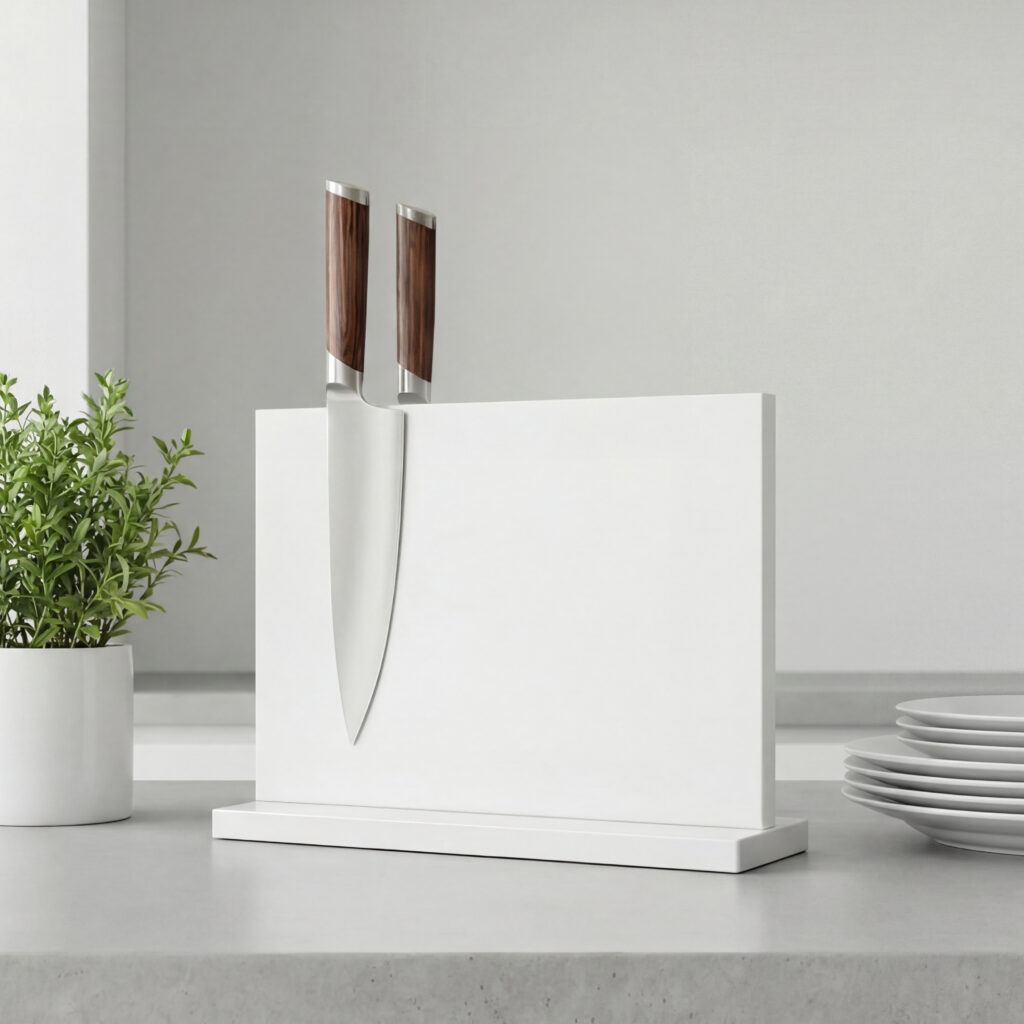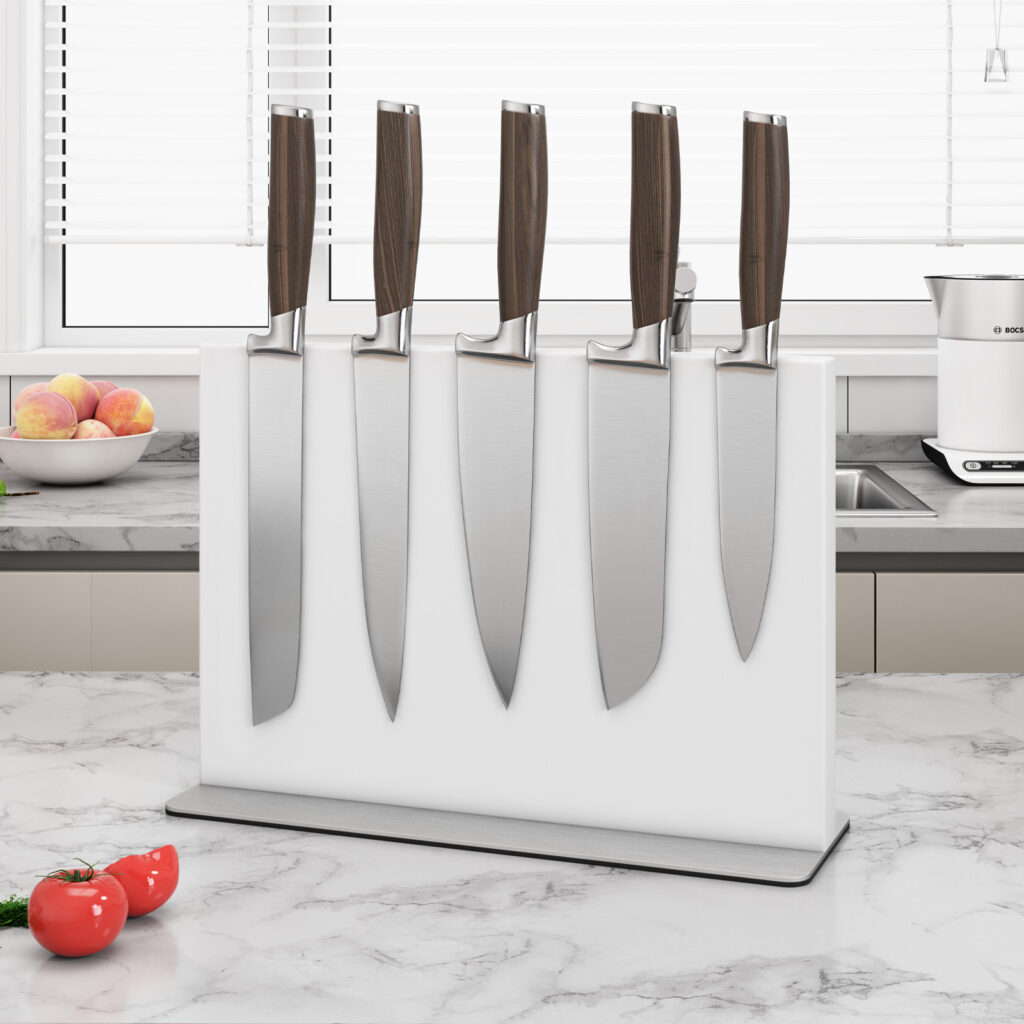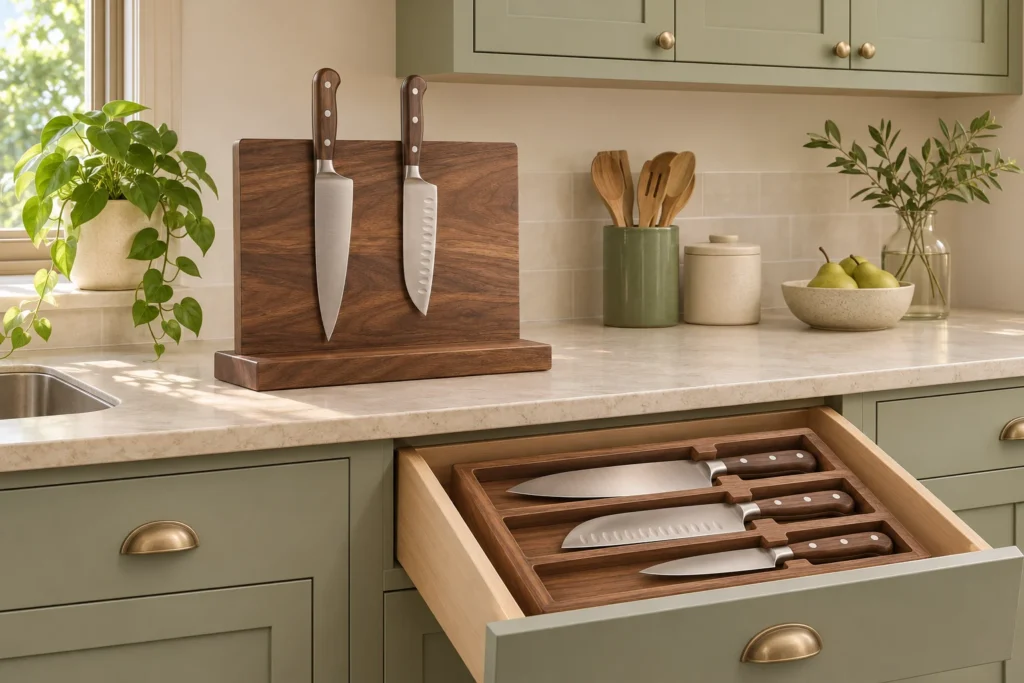
AI-generated concept illustration; not a THMINS product photograph, installation diagram or performance test.
In a kitchen used by two cooks, good knife storage needs to work from more than one person’s position. A holder that is convenient for one chopping board may force the other cook to reach across a work area. Begin with where each person prepares food, then choose an accessible storage location.
Map the movements before moving the knives
With knives safely stored, walk through an ordinary meal together. Identify where vegetables are prepared, where dishes are washed and which routes cross. Mark a possible holder footprint with paper and check whether either person would need to reach past the other’s hands.
The objective is a predictable route to the right handle. It is not to place the holder at the exact geometric centre of the counter.
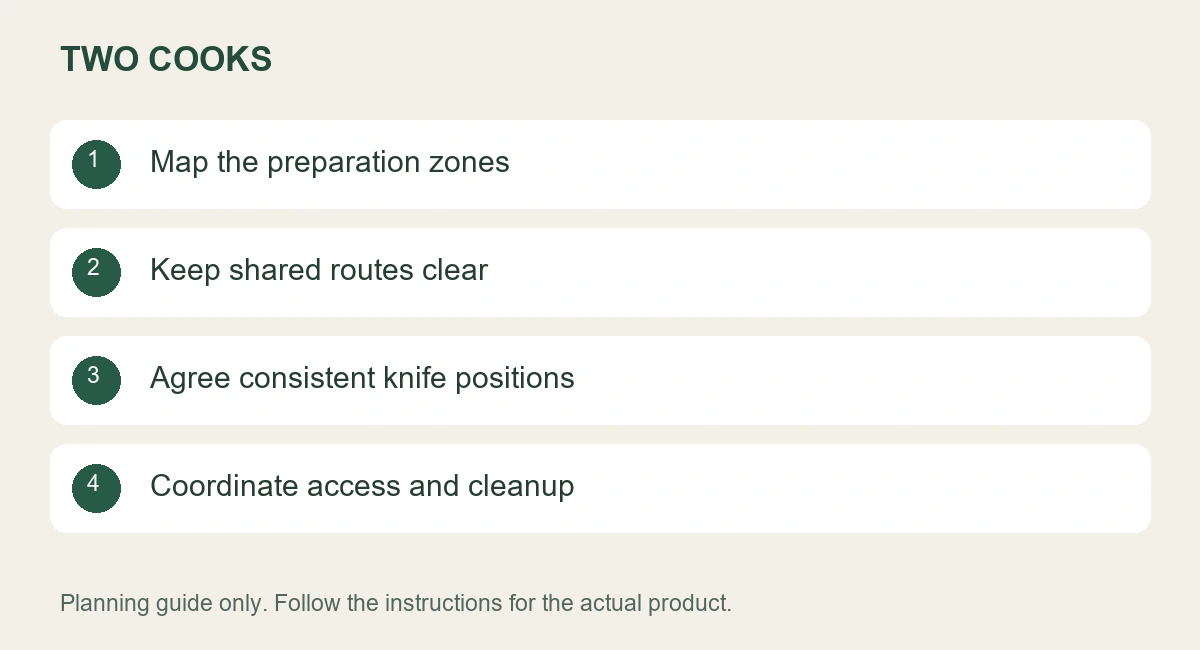
Illustrated planning checklist; follow model-specific instructions.
Give commonly used knives consistent positions
Agree where each knife is returned after cleaning and drying. Keep the arrangement simple enough that a missing knife is noticeable. Avoid placing unrelated utensils between blades merely because there appears to be unused space.
If both cooks use a similar knife at the same time, plan storage for the actual two knives rather than relying on one position that is repeatedly shared. Check handle access and blade separation for the complete layout.
Examine an island from both sides
A double sided holder can be approachable from different directions, but the outside face may also be accessible to visitors. Consider normal household movement and choose another storage arrangement where exposed knives are unsuitable.
| Shared activity | Layout question |
|---|---|
| Two chopping boards in use | Can each cook reach storage without crossing the other workspace? |
| Washing and returning knives | Is the return path clear of food preparation? |
| Opening drawers | Does movement interfere with the holder? |
Keep cleanup responsibilities clear
Agree who returns knives and when the holder is emptied for cleaning. Do not leave an unannounced knife under a towel or among washing-up items for the other person to discover. Each knife should have a known protected location during cleanup.
Separate preparation zones from shared routes
Include the tasks that happen between meals, such as putting groceries away or making drinks. A route that is clear during dinner preparation may be busy at breakfast when cupboard doors and appliances are in use. Choose a storage position that remains understandable across those routines. If one location serves only a single activity well, compare it with another before treating it as the permanent shared arrangement.
Two people can work at adjacent counters without needing separate complete kitchens. Identify which spaces are used for chopping, washing, cooking and setting down hot or bulky items. Then mark the routes between those tasks. A knife holder should not require one cook to reach across the other’s chopping board or stand in the path of a pan moving from the hob.
Plan with the knives safely stored and use a paper footprint for the proposed holder. Each cook can walk through the movements using empty hands. This reveals access conflicts without turning the planning exercise into a test around exposed blades. If the route is awkward even without knives present, reconsider the location before loading a holder there.
Make the layout understandable to both people
Agree on a simple order for the knives and keep it consistent. Organising by the knives you both recognise is usually more useful than a display arranged solely for visual symmetry. When one cook changes a position, tell the other rather than assuming the new arrangement is obvious from a distance.
Pay attention to differences in how each person approaches the holder. Height, preferred hand and working position can change which handles are easy to reach. Choose an arrangement that allows both people to follow the manufacturer’s handling guidance. Do not invent a different removal technique for one person merely to preserve an inconvenient layout.
Decide how a knife is requested during cooking
If one person is using the knife the other needs, agree to communicate rather than reaching into the active work area. Keep the storage routine separate from handing tools between people. A clear verbal request and a deliberate pause are easier to coordinate than an unexpected reach across a chopping board.
Return a finished knife to its appropriate cleaning or storage stage rather than leaving it on an unfamiliar part of the counter. The next person should not need to determine whether a knife hidden among ingredients is clean, in use or waiting to be washed. Consistent locations reduce that ambiguity.
Avoid treating the holder as a shared utensil rack
In a busy kitchen, small tools can gradually accumulate wherever a gap appears. Keep the magnetic holder limited to the items the manufacturer intends it to store. Scissors, peelers and sharpening tools may have different shapes and attachment requirements. Their attraction to a surface alone does not make them suitable additions.
Provide another organised location for those utensils so they do not compete with knife handles. This also makes it easier to see when a knife has been returned to the wrong position or when the layout has become crowded. A holder that is simple to understand is more useful during cooking than one that displays every metal tool available.
Review the arrangement after a normal meal
After using the kitchen together, discuss where either person had to wait, reach around an obstacle or move another item. Review the empty layout before making changes. You may discover that moving a drying rack or relocating a chopping board solves the issue without changing the knife storage at all.
Repeat the review when a new appliance or knife changes the workspace. Shared kitchens evolve, and a previously clear access route can become crowded gradually. Treat the holder’s location as part of the overall preparation arrangement rather than a decorative object that must stay in one place permanently.
What if guests help with cooking?
Explain the knife positions and handling instructions before they use the storage. If a guest is unfamiliar with the holder, do not assume they know the intended removal movement. Where several people create an unsuitable access pattern, reorganise the task or use an appropriate protected storage arrangement.
Can we use opposite faces at the same time?
Follow the product’s instructions and avoid assuming that two storage faces imply simultaneous use by two people. Coordinate access so one person’s movement does not surprise the other. Ask the supplier about the intended use if this is an important requirement for your kitchen.
Should each cook have a separate holder?
Only if the kitchen has suitable space and the separate arrangement improves access. Two crowded blocks can create more obstacles than one carefully located storage system.
Does visible storage suit every household?
No. Consider everyone who can access the kitchen, not just the two cooks. Protected storage with appropriate access controls may be more suitable. For placement fundamentals, see the small kitchen placement guide.