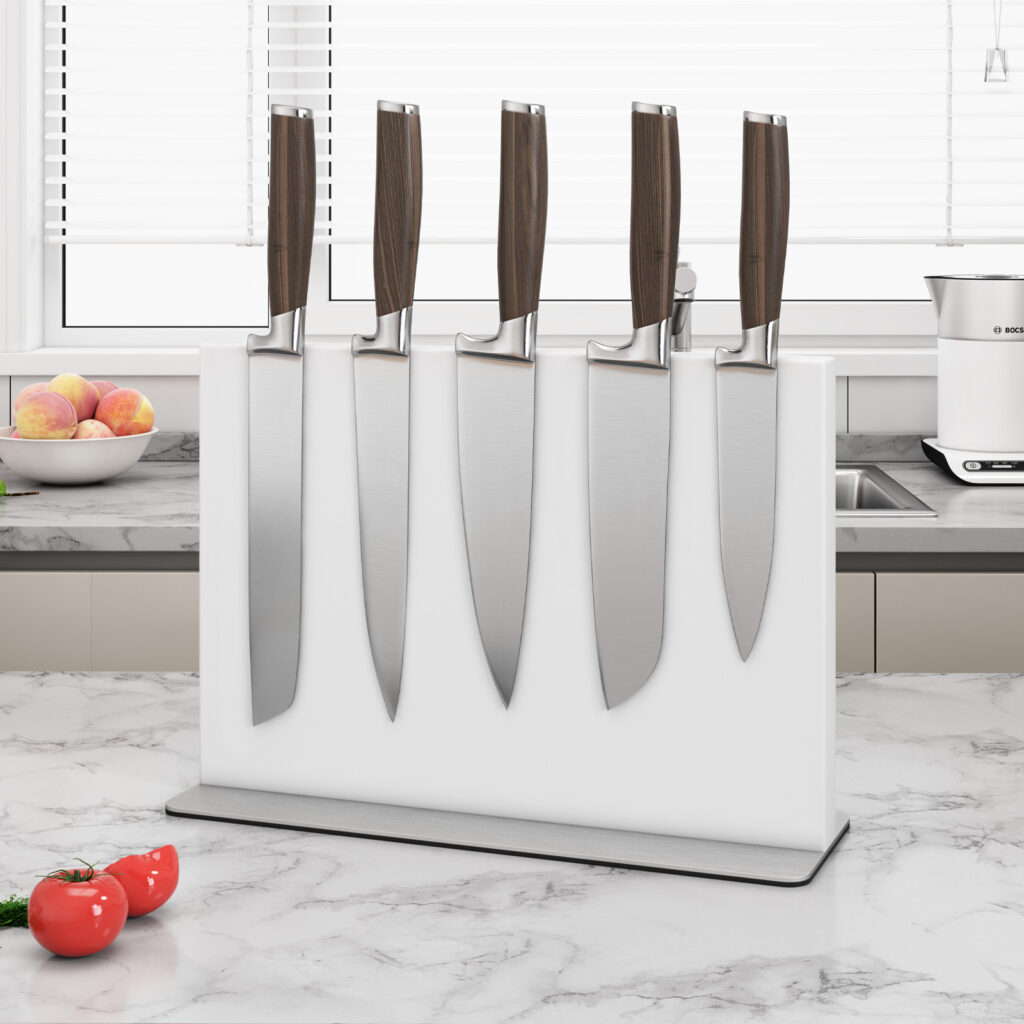
AI-generated concept illustration; not a THMINS product photograph, installation diagram or performance test.
A collection assembled over several years rarely matches the uniform knives in a product photograph. Your chef knife, small utility knife and long slicer may have very different handles and blade shapes. Plan their storage individually before deciding how many belong on a magnetic holder.
Make a short inventory
List the knives you use regularly, along with model names and available dimensions. Separate everyday tools from knives used only for an occasional task. This helps you reserve accessible storage for the knives you actually reach for.
Use manufacturer dimensions where available. Keep the knives protected while preparing paper outlines or a layout sketch; there is no need to crowd exposed blades together to estimate a capacity.
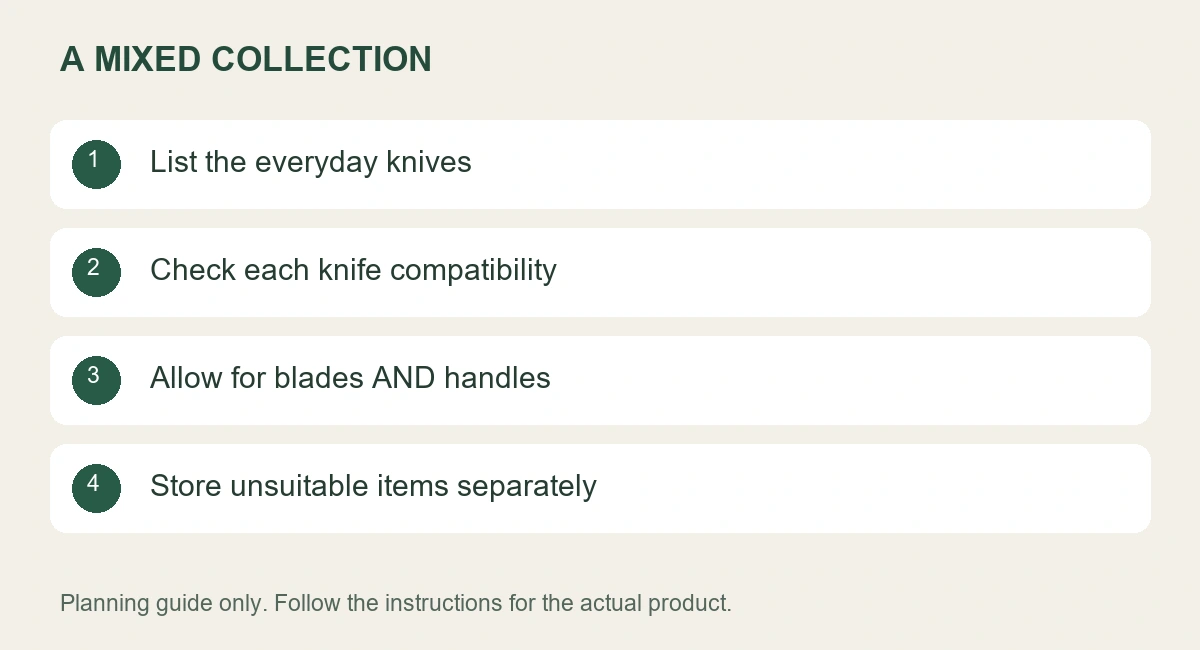
Illustrated planning checklist; follow model-specific instructions.
Check compatibility knife by knife
Do not assume a holder suits every knife because one chef knife attaches well. Confirm the blade material and model with the knife and holder manufacturers. A ceramic blade, for example, does not provide the same magnetic attachment as a compatible steel blade.
Shape matters as well. A projecting bolster or unusual handle may affect how the knife sits in the intended storage position. Do not modify the knife or add loose magnets to compensate for an unsuitable fit.
Arrange around usable access
| Knife feature | Storage question |
|---|---|
| Long blade | Does the tip clear the base in the approved position? |
| Wide blade | Is adjacent storage still accessible? |
| Bulky handle | Can you grip it without touching another blade? |
| Unusual profile | Does it sit as the holder is designed to support it? |
There is no need to create a perfectly symmetrical display. A practical layout gives every stored knife a clear position and keeps the intended contact areas unobstructed.
Keep a second storage option when needed
An incompatible or awkwardly shaped knife can remain in a suitable sheath, insert or other protected storage recommended for it. One deliberate secondary location is preferable to forcing the entire collection onto one holder.
Divide the collection by use before dividing it by size
Include the knives used by other household members in this inventory. A tool that you rarely reach for may be part of someone else’s daily routine. Discuss which knives belong in the shared accessible positions before reorganising the collection. Keep separate protected storage easy to identify so an occasional tool is not mistaken for a missing everyday knife or returned to an unsuitable magnetic position after washing.
Start with the knives used during an ordinary week. A chef knife, utility knife and bread knife may all be regular tools, while a carving knife or specialist blade may be used much less often. Put the regular group into the initial layout, then consider whether adding the occasional tools would compromise access. This prevents the least-used item from determining the footprint of the entire everyday storage system.
Do not assume that a matched set needs to remain together in one display. It may be more practical to keep several regular knives accessible and the remaining pieces in suitable protected storage. Conversely, a collection from different manufacturers can work together if each knife is compatible and the complete layout is appropriate for the holder.
Make an inventory that a supplier can answer
For each knife, record the manufacturer and model, blade length, widest blade dimension and any unusual handle or bolster feature. Include weight when it is known and relevant to the supplier’s assessment. Use product specifications where possible, and identify estimates as estimates rather than presenting them as measured facts.
Add a photograph of the knife only if it can be taken in a suitable protected setup. There is no need to arrange the entire collection with edges exposed for an attractive group photograph. The purpose is to communicate fit details, not to demonstrate attachment before compatibility has been established.
Think about the space occupied by handles
Two narrow blades may fit close together on a board while their handles prevent comfortable gripping. Conversely, a broad blade may require generous width even when its handle is small. Plan around the envelope of the entire knife in its intended position, not only the most convenient dimension from the specification.
Handle shape also affects how a person approaches it. Consider the actual grip and removal motion recommended for the holder. A layout that requires pushing another handle aside or passing fingers close to an adjacent edge is a reason to reduce crowding or use another storage position.
Keep collection changes deliberate
When adding a new knife, repeat the compatibility and layout checks instead of placing it in the first visible gap. The available gap may lie outside the intended attachment area or may be needed for access to a neighbouring handle. Adding one knife can change the practicality of the whole arrangement even when the overall count remains below an advertised capacity.
If a new blade replaces an older everyday knife, decide where the older one will go. Leaving redundant tools on the holder can gradually turn a clear layout into a crowded display. Reassess what you actually use rather than buying a larger holder automatically whenever the collection grows.
Keep materials and care instructions distinct
A mixed collection may include knives with different cleaning and maintenance requirements. Store them only after completing the care appropriate to each knife. Do not assume that every handle tolerates the same treatment or that the holder’s maintenance instructions apply to the knives resting on it.
Keep product care information accessible, particularly for an unusual finish or handle material. If one knife requires a separate protected storage arrangement, label or organise that location clearly enough that another household member does not return it to the magnetic holder by habit.
What if the knife attaches but sits at an unexpected angle?
Do not treat attachment alone as confirmation of suitable fit. Check whether the knife is in the intended position and whether its shape prevents the approved contact arrangement. Stop using that combination until the manufacturer or supplier clarifies it; avoid adding spacers or loose magnetic components.
Should the most expensive knife get the largest gap?
Plan suitable access and separation for every knife. Price does not determine the clearance required by its shape or the compatibility of its blade. An expensive knife may deserve particular care, but a lower-priced tool should not be crowded into a position that is unsuitable to use.
Can I include scissors or a sharpening tool?
Only when the holder is intended for that item and the manufacturer confirms the placement. Attraction to a surface alone does not establish suitable storage for a tool with different geometry.
How much space should I reserve for future purchases?
Plan around an identifiable addition rather than a vague maximum collection. If you expect to buy a long slicer, its likely height and handle access matter more than an extra nominal knife position.
Use the size guide to turn the inventory into questions for the supplier.