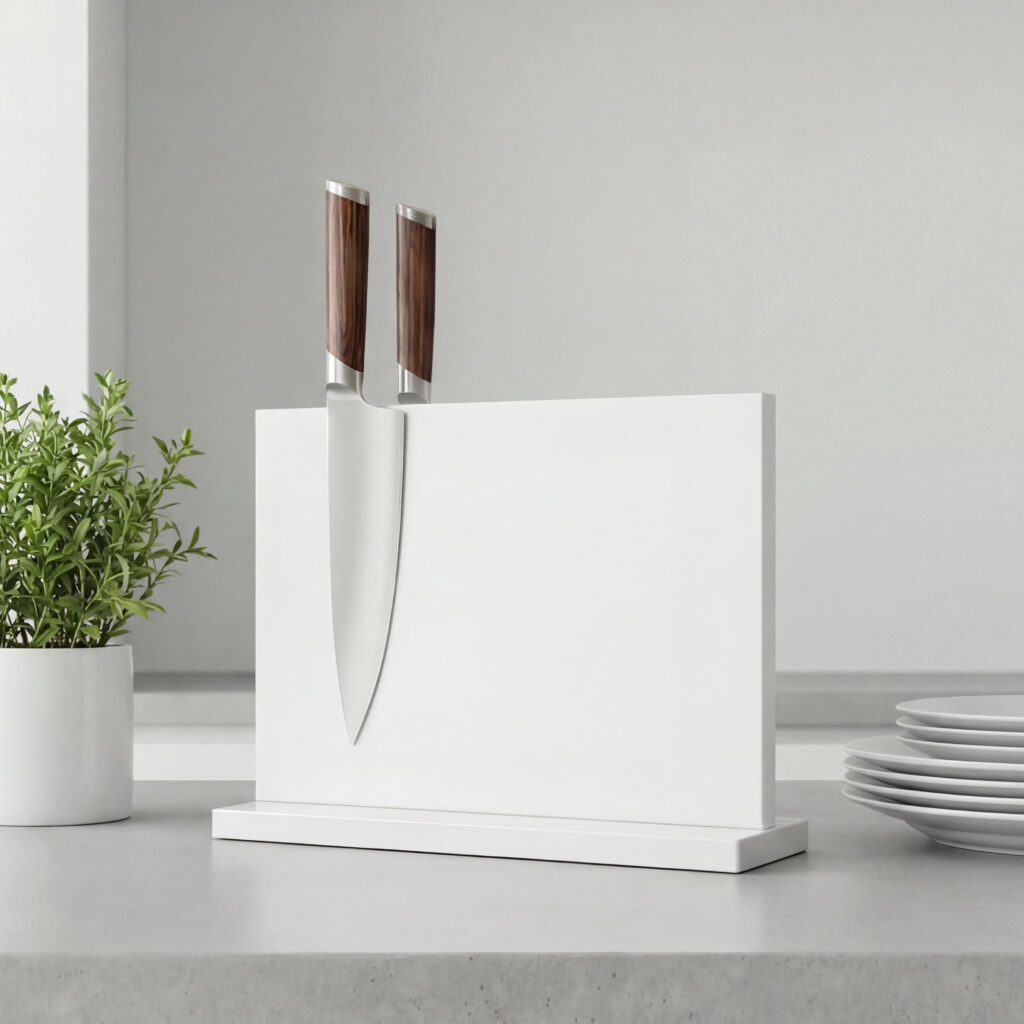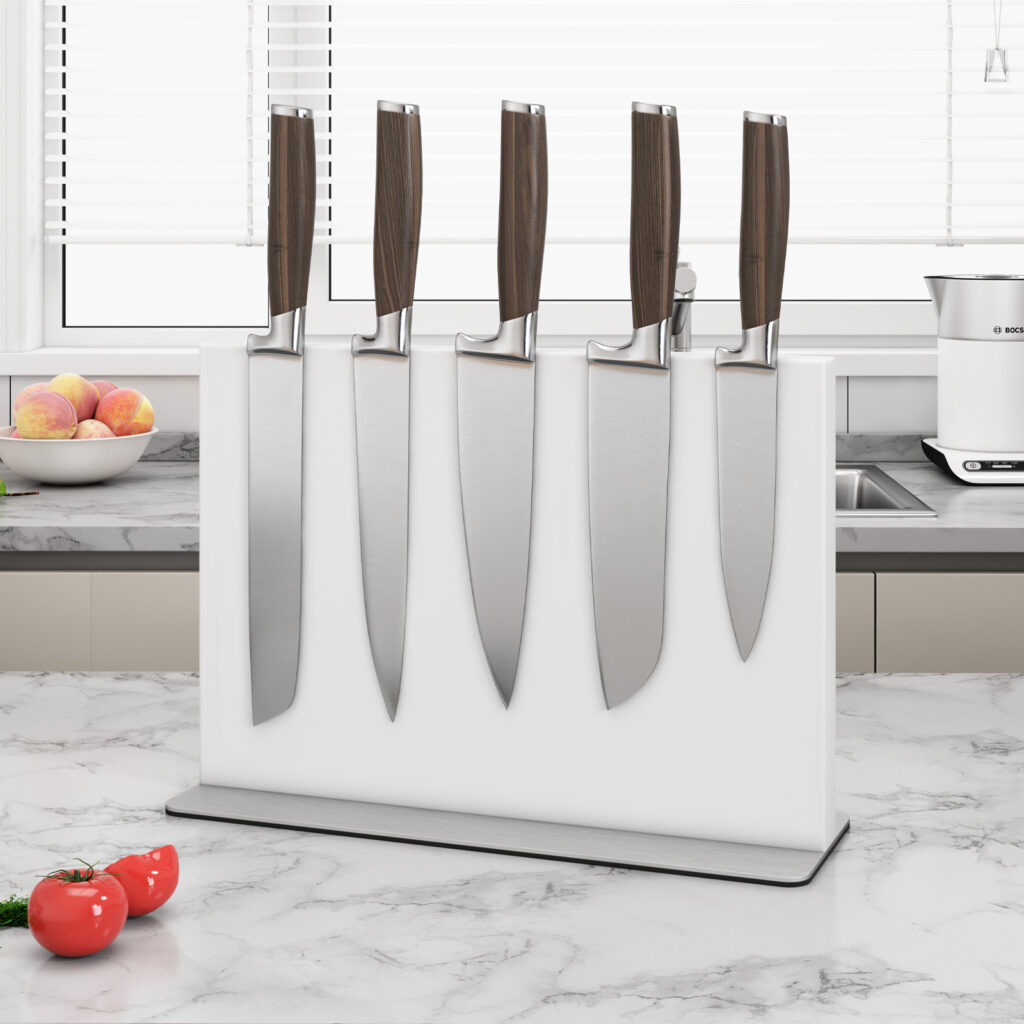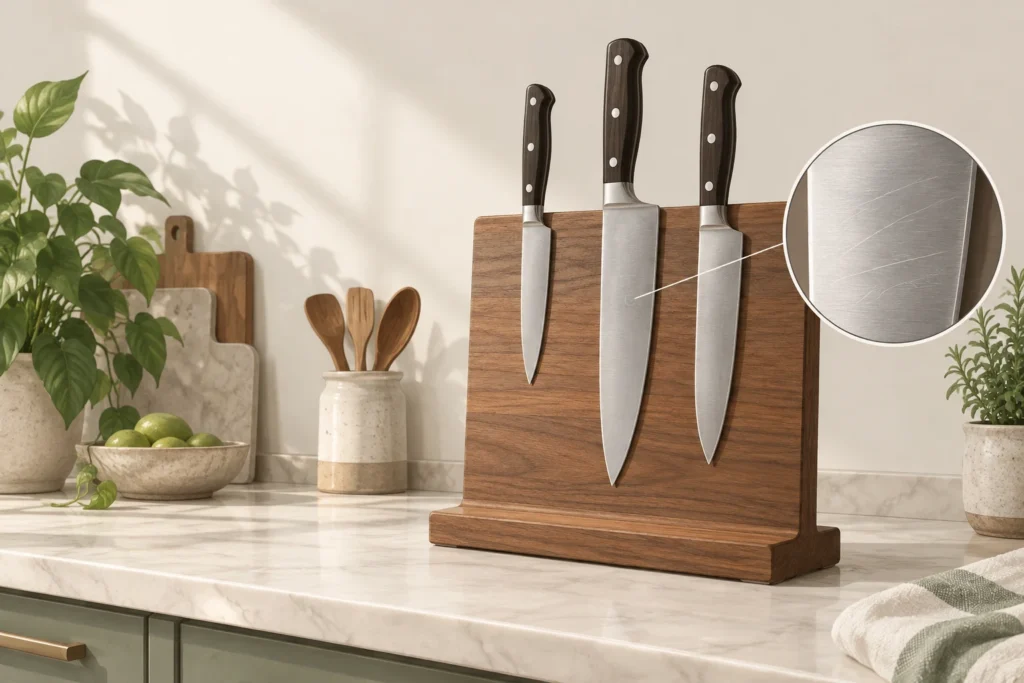
AI-generated concept illustration above; not a Thmins product photograph or test result.
Magnetic knife holders can leave scratches if a blade rubs against the contact surface. A knife can also be damaged if its edge or tip strikes a hard part of the holder. That does not mean every magnetic holder will damage every knife: the surface, the fit and the way you put the knife away all matter.
Before buying, separate three concerns: marks on the blade face, damage to the cutting edge, and wear on the holder itself. They call for different checks.
What kind of damage are you concerned about?
| What you notice | What to check |
|---|---|
| Fine lines on the flat side of the blade | Whether the blade slides across the holder; inspect the contact surface for debris, roughness or wear. |
| A chip or other visible change at the cutting edge | Whether the edge touches the holder, base or another knife. Have a damaged edge assessed before continuing to use it. |
| A mark or dent at the knife tip | Whether there is enough usable height for that knife in its storage position. |
| Marks on the holder rather than the knife | Check the holder’s finish and care instructions; surface wear is a separate issue from blade damage. |
A cosmetic mark on the middle of a blade is different from a chip at its cutting edge. Check where a mark actually is before deciding what needs to change.
What owners like—and what sometimes disappoints them
The appeal is easy to understand: visible knives, accessible handles and a display that can suit the kitchen. On Cangshan’s HUA block review page, owners praise its appearance and double-sided storage. One buyer also reports that the holder’s finish scratches easily. That review is marked as incentivized. These are experiences with that particular product, not findings about Thmins. Cangshan customer reviews
A detailed owner comparison of two countertop blocks describes a different concern: faint marks on a knife blade. It also reports cleaning difficulties around a fixed guard and a block that moves or tips when a knife is pulled directly outward. This is an individual account, but it highlights useful questions to ask before choosing a holder. Owner comparison
The useful buying question is: can this holder keep your particular knives separated, supported and easy to remove without scraping them across the surface?
Does a wooden surface guarantee scratch-free storage?
Do not treat the material name as a scratch-free guarantee. The owner comparison above includes a report of blade marks from a bamboo block. That observation does not establish that all bamboo or wooden holders behave the same way.
Ask what actually touches the blade. A product described as stainless steel may have a coating; an acrylic component may be a guard rather than the magnetic contact face. The finish, exposed hardware and the path the knife must follow during removal deserve attention alongside the material.
When comparing models, look for close-up photographs of the contact area and instructions for cleaning it. If preserving a polished or decorative blade finish is a priority, ask the knife maker about suitable storage and the holder seller about the specific surface.
Choose a holder that fits the knife, not just the counter
Measure your longest knife in its intended storage position. The holder’s overall height may include a base that provides no usable clearance for the blade. The tip should not rest on that base or on the countertop.
Width matters too. Plan room for the widest blades and for your fingers around each handle. An advertised knife count cannot describe every combination of a broad cleaver, chef’s knife, bread knife and small utility knife.
Check the space above and around the holder. A protective panel may require the knife to be lifted upward, so a setup that fits beneath a cabinet can still be awkward to use. Double-sided storage also needs room to reach the back comfortably.
Finally, ask about removal. A knife remaining attached and a base remaining steady are two different requirements. If you cannot remove a knife in a controlled way using the manufacturer’s instructions, stop using that combination and contact the seller.
Everyday habits that reduce avoidable contact
Use the instructions supplied with your holder and knives. As a general care checklist:
- Clean and dry the knife before storing it. Open storage is not a substitute for drying. WÜSTHOF’s knife-care guidance recommends careful drying before returning knives to storage. WÜSTHOF care guide
- Keep the contact area clean. Remove knives before cleaning the holder and use its specified cleaning method. Check for rough spots or damaged finishes before putting knives back.
- Guide each knife into place. Keep control of the handle and avoid allowing the blade to snap against the surface. Keep the cutting edge and tip clear of hard parts.
- Avoid sliding the blade across the face. Follow the maker’s removal method; stop if the holder shifts or the knife catches on a guard.
- Keep knives separated. Leave enough room to remove one without hitting the next blade or handle.
Do not add tape, leather or another homemade covering without checking with the holder manufacturer. Such a change alters the surface and the distance between the blade and the magnets; the original holding performance should not be assumed to remain the same.
What if you notice a scratch?
Remove the knife carefully and inspect both surfaces in good light. Check whether the mark is on the blade face, the cutting edge, the tip or the holder. Photograph it and note where the knife was stored and whether you had to slide it to remove it.
If there is roughness, loose hardware, a damaged guard or a knife that will not stay securely in place, stop using the affected storage position and contact the seller. Do not deliberately repeat a damaging motion to prove the problem.
For a decorative blade finish, ask the knife maker before trying abrasive polish. A treatment intended to remove a mark may also change the surrounding finish.
Questions to ask before ordering
- What material and finish will actually touch my blades?
- What is the usable height above the base?
- Is there room for my widest knife and enough separation between handles?
- How should knives be removed, and does a guard restrict that motion?
- Can the contact area be reached for cleaning?
- What evidence is available for compatibility with knives like mine?
When comparing the Thmins magnetic knife holder collections, start with those fit and care questions, then choose the finish you prefer. If a measurement or compatibility detail is missing, contact Thmins before ordering.
Frequently asked questions
Is a scratch on the blade the same as a dull edge?
No. A surface mark on the flat side and a change at the cutting edge are different observations. Inspect the edge separately rather than judging sharpness from the appearance of the blade face.
Is the strongest magnet always the best choice?
Holding securely and releasing predictably both matter. Ask about the combination of knife compatibility, contact surface, removal method and base stability rather than choosing from a strength claim alone.
Can I store a knife while it is still wet?
Dry it first. Follow the knife maker’s care instructions and do not rely on an open magnetic holder to dry moisture trapped at the contact area.
Should I expect every magnetic holder to be scratch-free?
No. Look for product-specific information and suitable handling instructions. Neither a material label nor another buyer’s experience guarantees that your knife’s finish will remain unmarked.